Everything You Need to Know About Dramatic Irony
Discover what is dramatic irony in literature, film & TV. Master examples from Romeo & Juliet to Breaking Bad & write your own!
What Is Dramatic Irony? A Quick Answer
At Edible LA, we believe that every great meal — and every great story — is built on the layers of what is revealed and what remains hidden. Whether you're a diner in Silverlake or a reader of our quarterly magazine, you've likely encountered one of the most powerful tools in storytelling: dramatic irony.
What is dramatic irony is one of the most searched questions in literary terms — and the answer is simpler than you might think.
Dramatic irony is when the audience knows something that a character in the story does not. This gap in knowledge creates tension, humor, or emotional impact.
Here's a quick breakdown:
- Who knows what: The audience has key information. The character is in the dark.
- What it creates: Suspense, dread, comedy, or heartbreak — depending on the story.
- Where you've felt it: That moment you wanted to yell "Don't go in there!" at a horror movie screen. That's dramatic irony.
Think of Romeo drinking poison while the audience knows Juliet is still alive. Or watching Walter White's family trust him while we know exactly who he really is. The story hits harder because we know more than the characters do.
It's one of the oldest storytelling tools in the world — born in ancient Greek theater and still driving some of the most gripping scenes on screen today.
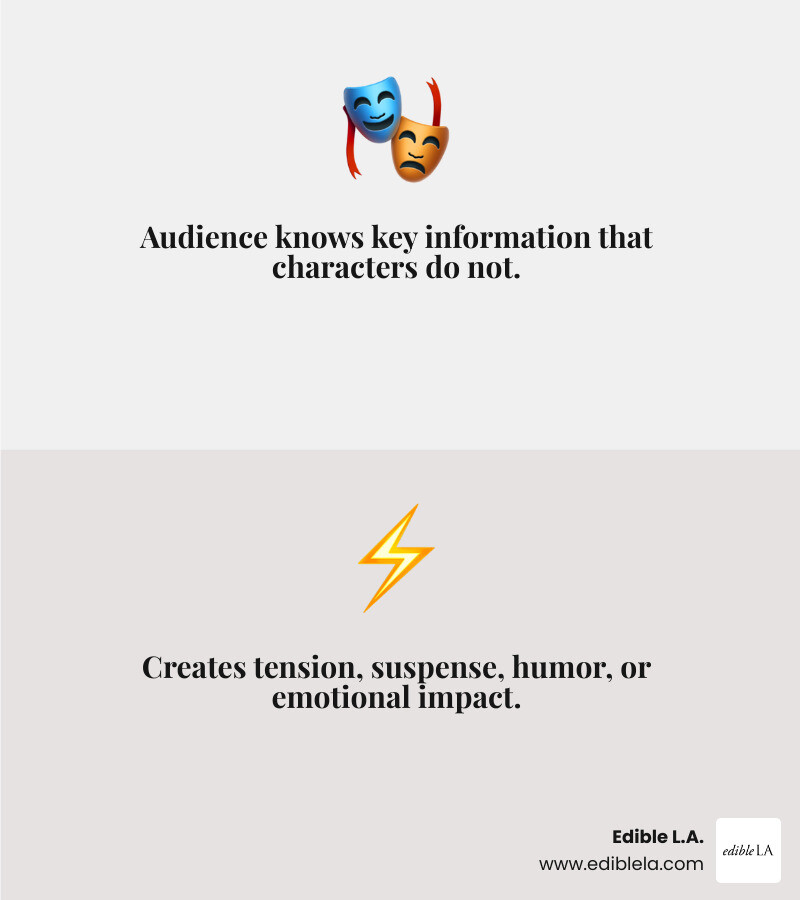
Dramatic irony shows up in every medium — ancient plays, Shakespeare, blockbuster films, prestige TV, and even local storytelling. Let's break down exactly how it works, why writers use it, and how you can spot (or use) it yourself.
Understanding What is Dramatic Irony in Literature and Film

To truly grasp what is dramatic irony, we have to look at its roots. The term finds its origins in ancient Greek drama, specifically from the word eironeia. In Greek comedy, the eiron was a character who used their wit and feigned ignorance to outsmart a boastful opponent, the alazon. Over time, this evolved into a sophisticated narrative device where the "ignorance" isn't feigned by the character, but is a literal lack of information that the audience happens to possess.
At its core, dramatic irony functions by giving the audience a sense of "superiority." We aren't better than the characters, but we are certainly better informed. This creates a fascinating psychological layer to storytelling. In food journalism, we often see this play out in the "theater" of the kitchen or the high-stakes environment of a Los Angeles restaurant opening. When we know a character is walking into a trap, our heart rate climbs. We aren't just watching a story; we are participating in the secret.
According to the Merriam-Webster definition, it is a situation in a drama that is grasped by the audience but not by the characters in the play. This definition highlights the "theatrical" nature of the device. While it works beautifully in novels and films, it was practically built for the stage. In a theater, the audience is fixed in their seats, watching the entire scope of the world, while characters enter and exit, often missing the very conversations that seal their fates.
Dramatic Irony vs. Verbal and Situational Irony
One of the biggest hurdles in understanding what is dramatic irony is confusing it with its cousins: verbal and situational irony. While they all share the name "irony," they function in very different ways.
| Feature | Dramatic Irony | Verbal Irony | Situational Irony |
|---|---|---|---|
| Who knows the truth? | The audience/reader. | The speaker (usually). | No one until it happens. |
| Core Mechanism | Information gap. | Contrast between words/meaning. | Contrast between expectation/reality. |
| Typical Effect | Suspense or empathy. | Humor, sarcasm, or wit. | Shock, reflection, or irony of fate. |
| Example | We know the "secret" ingredient is a common weed. | "Perfect!" (looking at a burnt soufflé). | A food critic gets food poisoning. |
As noted in the Wikipedia overview of irony types, verbal irony is often confused with sarcasm. However, sarcasm usually carries an edge of ridicule or "tearing flesh," whereas verbal irony can be a gentle play on words.
Situational irony, on the other hand, is about the "twist." It’s the "nothing is written in stone" sign that is, ironically, carved into a stone. Dramatic irony doesn't need a twist at the end; in fact, it often works best when we know exactly how the story will end from the very beginning.
The Mechanics of Storytelling: How It Works
Mastering what is dramatic irony requires understanding how to manage information. The legendary filmmaker Alfred Hitchcock famously explained this using the "bomb under the table" theory. If a bomb goes off and the audience didn't know it was there, you have fifteen seconds of surprise. But if the audience knows the bomb is there and the characters are just chatting away, you have fifteen minutes of heart-pounding suspense.
In a culinary setting, this might be the audience knowing a food critic has just sat down at a Silverlake cafe, while the distracted chef is busy arguing with a server. The tension builds because we know the stakes, even if the characters don't.
The Three Stages of What is Dramatic Irony
In professional writing and screenwriting, dramatic irony usually unfolds in three distinct stages:
- Preparation (Installation): This is where the audience is given the "secret." We see the villain plant the evidence, or we hear the doctor give a diagnosis that the protagonist hasn't received yet.
- Suspension (Exploitation): This is the "meat" of the story. The character goes about their day, making plans and saying things that are unknowingly counter-productive. The tension builds because we are waiting for the "other shoe to drop."
- Resolution (Retribution): The moment the character finally learns the truth. This is often the climax of a scene or the entire story. The information gap is closed, and the character must deal with the fallout.
Tragic Irony and the Hero's Downfall
When dramatic irony is used in a tragedy, it is often called tragic irony. This is deeply tied to the concept of hamartia, or the hero's tragic flaw.
Take the classic example of Oedipus Rex by Sophocles. The audience knows from the start that Oedipus has killed his father and married his mother. Oedipus, however, spends the entire play hunting for the "murderer" who has brought a plague upon his city. Every time he curses the killer, he is unknowingly cursing himself. This creates a profound sense of pity and fear in the audience—we want to stop him, but we are powerless to do so. His inevitable fate is what makes the irony so "tragic."
Famous Examples Across Different Media
To see what is dramatic irony in action, we can look at everything from the high-brow stages of London to the animated world of Pixar.
Classic Literature and Theater
Shakespeare was arguably the master of this device. In Hamlet, we watch as Polonius hides behind a tapestry to spy on Hamlet and his mother. We know he’s there; Hamlet does not. When Hamlet sees the tapestry move and stabs it, thinking it’s the King, the audience feels the shock of the mistake before the character even sees the body.
In Othello, the audience is fully aware of Iago’s villainous schemes, while Othello trusts him implicitly. Every time Othello calls him "Honest Iago," the audience winces. You can find more deep dives into these theatrical moments via the Dramatic irony in theater archives.
Modern Examples of What is Dramatic Irony in TV and Film
Modern creators in Hollywood use dramatic irony to keep us glued to our seats (or our phones).
- Toy Story: The entire premise relies on dramatic irony. We know the toys come to life when humans leave the room. The humor and heart of the movie come from the toys trying to maintain this secret while Andy remains oblivious.
- Breaking Bad: For much of the series, we know Walter White is a meth kingpin. His wife, Skyler, and his DEA agent brother-in-law, Hank, do not. This creates unbearable tension during family dinners and backyard BBQs.
- The Truman Show: Truman Burbank is the only person on Earth who doesn't know his life is a 24/7 reality TV show. We, the "real" audience, watch him live in a giant dome, creating a meta-layer of irony.
- The Office: The mockumentary format is a goldmine for dramatic irony. Characters often reveal their true feelings or secret plans to the camera lens, while their coworkers remain completely unaware in the next room.
For those looking for a lighter take, Lemony Snicket explains dramatic irony in a way that is both educational and hilariously grim. You can also browse an extensive list of media examples to see how your favorite shows use this trick.
How to Incorporate Dramatic Irony into Your Own Stories
Whether you are writing a screenplay in a coffee shop in Santa Monica or drafting a memoir about your family's history in Echo Park, understanding what is dramatic irony can elevate your writing.
- Decide on the "Secret": What does the audience need to know that will make the character's actions more meaningful? It should be something that directly affects the character's goals or safety.
- Expose the Ignorance: Show the character making a choice based on their limited knowledge. If they knew the bridge was out, they wouldn't drive over it—so show them happily singing along to the radio as they approach the cliff.
- Build the Tension: Don't reveal the truth too quickly. Let the audience sit with the discomfort. This is where the emotional engagement happens.
- Stage the Resolution: When the secret comes out, make it count. The revelation should change the character's world or their understanding of themselves.
Even in narrative nonfiction, like the stories we share at Edible LA about our local food system, dramatic irony can play a role. A memoirist might write about their younger self’s dreams of opening a restaurant in Downtown Los Angeles, while the reader (and the older narrator) knows the global events that would eventually change those plans. This creates a poignant, reflective tone.
For a more simple explanation of irony, you can always revisit the basics to ensure your story's foundation is solid.
Frequently Asked Questions about Dramatic Irony
What is the difference between dramatic and verbal irony?
Verbal irony is about what is said (saying the opposite of what is meant), while dramatic irony is about what is known (the audience knowing more than the character). You can have both at once—for instance, if a character says "I'm so safe here!" while the audience sees a shark swimming right behind them.
Can dramatic irony be used in nonfiction writing?
Absolutely. It is a powerful tool in biographies and history. We know how the Civil War ended or what happened to the Titanic, but writing about the people involved as they made their decisions—unaware of the coming outcome—creates a powerful sense of dramatic irony.
Is foreshadowing the same as dramatic irony?
Not exactly, though they are friends. Foreshadowing is a hint of what is to come. Dramatic irony is a full reveal to the audience while the character remains in the dark. Foreshadowing builds a mystery; dramatic irony builds suspense.
Conclusion
At Edible LA, we believe that every great story—whether it's the history of a heirloom tomato in Glassell Park or a classic play in Hollywood—relies on the connection between the storyteller and the audience. Understanding what is dramatic irony allows us to appreciate the layers of meaning in the narratives we consume every day.
By playing with the gap between what we know and what the characters believe, writers can create experiences that stay with us long after the curtain falls or the credits roll. It’s about building empathy, heightening the stakes, and making the audience feel like they are part of the journey.
Want to see how we apply storytelling to local food? Discover more in our seasonal produce guide and join us as we explore the rich, layered stories of Los Angeles, season by season.