Unforgettable Stories and Events at Black-Owned Farms Across the Country
Discover black owned farms stories of resilience, innovation, and land reclamation from Gilliard Farms to Soul Fire Farm.
The Roots of Resilience: Why Black Owned Farms Stories Matter
Black owned farms stories are some of the most powerful — and most overlooked — chapters in American history.
Here is a quick look at the key facts:
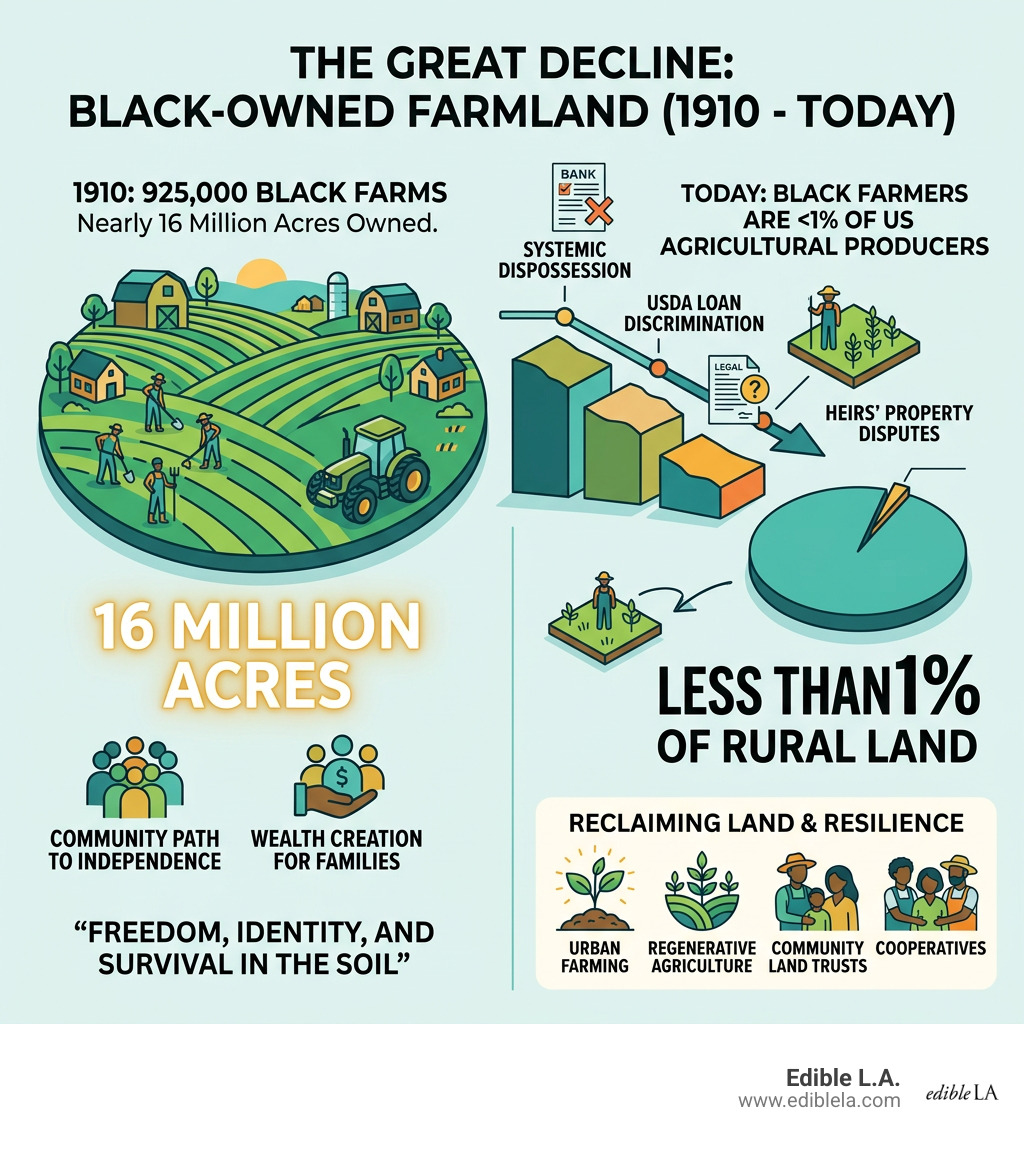
- 1910: Black farmers owned nearly 16 million acres of farmland and operated 925,000 farms across the US
- 1975: That number had fallen to just 45,000 farms
- Today: Black farmers represent less than 1% of the nation's 3.3 million agricultural producers
- Root causes: USDA loan discrimination, heirs' property disputes, development pressure, and systemic dispossession
- Bright spots: A new generation of Black farmers is reclaiming land through cooperatives, community land trusts, regenerative agriculture, and urban farming
The story of Black farming in America is not just about land. It is about freedom, identity, and survival.
After emancipation, Black families worked fiercely to own the soil beneath their feet. By 1910, they had built something remarkable — millions of acres of farmland, from coastal Georgia to the Mississippi Delta. Then, decade by decade, that land was taken through discriminatory loans, forced foreclosures, and outright fraud.
Today, just 1% of rural land in the US is owned by Black Americans.
But loss is only part of the story. Across the country — from a 150-year-old Gullah Geechee farm in coastal Georgia, to a 1,000-acre cattle ranch outside Houston, to urban plots in South Los Angeles — Black farmers are rebuilding. They are growing food, preserving culture, and creating spaces that feed both bodies and communities.
This collection of stories celebrates that resilience.
The Stolen Legacy: A History of Black Land Ownership
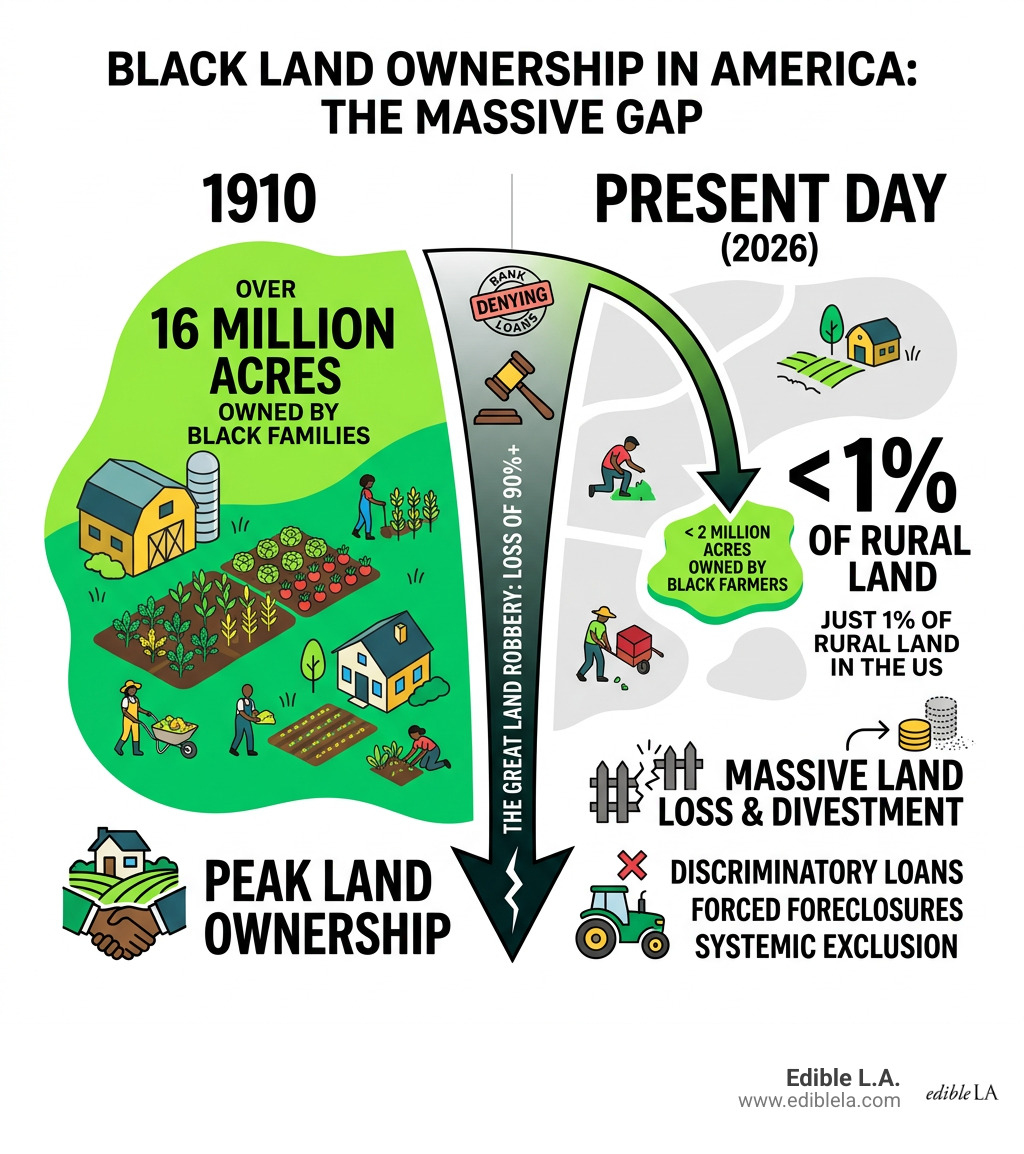
To understand modern black owned farms stories, we have to look back at the peak of Black land ownership. In 1910, Black Americans owned roughly 14 to 16 million acres of land. This was an incredible feat, achieved just a few decades after the end of the Civil War. Farming was more than a job; it was the primary path to independence and wealth for families who had been systematically denied both.
However, the 20th century saw what historians often call "The Great Land Robbery." Between 1920 and 1997, Black farmers lost more than 90% of their land. This wasn't just a result of market forces or the Great Migration; it was fueled by systemic dispossession. Discriminatory practices by the USDA, local banks, and legal loopholes regarding "heirs' property" (land passed down without a clear will) allowed developers and speculators to seize family legacies.
The impact of this loss is staggering. In 1920, there were nearly one million Black-owned farms in the U.S. By 1975, that number plummeted to just 45,000. Today, Black producers make up less than 1.4% of all farmers nationwide.
| Year | Number of Black-Owned Farms | Total Acres Owned |
|---|---|---|
| 1910 | ~925,000 | 16 million |
| 1975 | 45,000 | ~3 million |
| Today | ~49,000 | < 2 million |
The Impact of Systemic Barriers on Black Owned Farms Stories
The barriers faced by Black farmers were often institutional. For decades, the USDA functioned as a gatekeeper that frequently shut its doors. Black farmers reported significantly higher rates of loan denials and "supervised accounts," where the government dictated exactly how they could spend their own loan money—a level of scrutiny rarely applied to their white counterparts.
When Shirley Sherrod Was First Wronged by the USDA is a prominent example of this struggle. Sherrod, a lifelong advocate for land retention, saw how the denial of emergency loans during droughts led to the foreclosure of New Communities, Inc., the nation’s first community land trust.
The legal battle for justice eventually led to African Americans Have Lost Untold Acres of Land Over the Last Century and the historic Pigford v. Glickman class-action lawsuit. While the settlement provided billions in relief, for many, the money came too late to save the family farm. This history of The Great Land Robbery is the backdrop against which every modern Black farmer operates today.
Resilience in Action: Multi-Generational Farm Legacies
Despite these immense pressures, some families have held onto their land for over a century, creating some of the most inspiring black owned farms stories in our history.
One such beacon is Gilliard Farms. Located in coastal Georgia, this farm was founded in 1874 by Jupiter Gilliard, a man who had been enslaved before emancipation. Today, his descendants still tend the soil. The farm is a Georgia Centennial Farm, a rare designation for properties held by the same family for over 100 years. Their story is one of heritage and healing, where Gullah Geechee heritage—a culture rooted in West African agricultural traditions—is preserved through sustainable, pesticide-free practices.
In North Carolina, Stanley Hughes of Pine Knot Farms carries a similar torch. His family has farmed their land since 1912. Faced with the decline of the tobacco industry, Hughes transitioned to certified organic produce, proving that traditional farms can adapt and thrive. His collard greens even gained national fame, appearing in prominent food publications. These stories remind us that Black farming isn't just a part of the past; it is a living, breathing legacy.
Reclaiming the Cowboy Narrative with Lloyd Prince
When we think of the "Wild West," the image is often whitewashed, but history tells a different story: at least one in four cowboys was Black. Today, Lloyd Prince is reclaiming that narrative on a 1,000-acre ranch near Houston.
Prince, who grew up in the inner city, represents a new generation of Black cattle ranchers. He leads Prince Beef, a brand focused on grass-fed Angus cattle. By utilizing direct-to-consumer sales, Prince bypasses the traditional industry "squeeze" that often leaves small ranchers with thin margins. His journey from urban life to large-scale ranching highlights a growing trend of Black entrepreneurs returning to the land to secure food sovereignty for their communities.
Reclaiming the Soil: Modern Black Owned Farms Stories of Innovation
Modern black owned farms stories are often about more than just individual success; they are about collective power.
New Communities, Inc., founded by Shirley Sherrod and others during the Civil Rights movement, pioneered the community land trust model. After losing their original 6,000 acres to discriminatory USDA practices, they staged a triumphant comeback. In 2009, following the Pigford settlement, they purchased a 1,600-acre former plantation—turning a site of historical trauma into a place of healing, pecan cultivation, and agricultural training.
In California, we are seeing a similar surge of innovation. We’ve compiled a-list-of-black-owned-california-farms-to-support-right-now to help our L.A. community connect with these vital growers. These farms aren't just businesses; they are hubs for environmental justice and community health.
Urban Empowerment and Black Owned Farms Stories in Los Angeles
In Los Angeles, the movement for food sovereignty is taking root in the heart of the city. We are incredibly proud of the work being done in South L.A. and surrounding neighborhoods to combat "food apartheid"—a term that describes the systemic lack of access to healthy food in Black and Brown communities.
The Ron Finley Project in South L.A. is perhaps the most famous local example. Finley, the "Gangsta Gardener," transformed parkways into edible gardens, proving that urban spaces can be productive and beautiful. His work has inspired a wave of local initiatives, from vegan-soul-food-in-south-la to community gardens that serve as "hush harbors" for modern times.
Other local heroes include:
- Adventures to Dreams: A Long Beach-based program that uses hands-on gardening to mentor and empower youth.
- LA Green Grounds: A volunteer-led group that helps South L.A. residents install edible landscapes.
- Bloom Ranch of Acton: We encourage you to check out Inside LA County's largest Black-owned farm to see how large-scale sustainable ranching is happening right in our backyard.
These projects are more than just gardens; they are homegirl-heroes and community leaders working to ensure that every Angeleno has access to fresh, nutrient-dense food.
Ancestral Knowledge and Regenerative Practices
Many modern Black farmers are looking to the past to save the future. Ashanti Williams of the Black Yard Farm Collective and Leah Penniman of Soul Fire Farm are leaders in the regenerative agriculture movement. They argue that "modern" sustainable techniques like agroforestry, silvopasture, and no-till farming are actually ancestral practices that were stolen and renamed.
Rise & Root Farm, co-founded by the legendary Karen Washington, focuses on these same principles. Washington often tells the story of how growing her first tomato in a Bronx community garden changed her life. It moved her from seeing farming through the lens of historical trauma (slavery and sharecropping) to seeing it as a tool for liberation. By reclaiming the land, these farmers are also reclaiming their cultural birthright.
Cultivating the Future: Training and Policy Successes
The future of black owned farms stories depends on training the next generation. Organizations like Farms to Grow and the Black Urban Growers (BUGS) conference are providing the mentorship and networking needed for young Black farmers to succeed.
Policy is also shifting. The Justice for Black Farmers Act and recent debt relief initiatives in the Inflation Reduction Act are direct results of tireless advocacy by groups like the National Black Food and Justice Alliance. These policy wins are helping to stem the tide of land loss and provide a foundation for new growers.
In the Mississippi Delta, Pastor Bennie Brown and the Swan Lake Association are reviving a 150-year-old tradition of church-led farming. Their farm incubator program trains new farmers on 1-acre plots, helping them register as legitimate businesses and access the resources they need to scale.
Closer to home, we see this spirit of excellence in L.A. icons like rashida-holmes-la-icon, who uses her platform to highlight the importance of sourcing from local, diverse producers.
Frequently Asked Questions about Black Owned Farms Stories
Why did Black farmers lose so much land in the 20th century?
The loss of nearly 90% of Black-owned land was caused by a "perfect storm" of systemic issues. This included the USDA’s history of denying loans to Black farmers, the lack of legal protection for "heirs' property," and physical and economic intimidation during the Jim Crow era. As cities expanded, development pressure also led many families to sell or lose land to foreclosure.
How do Black-owned farms address food apartheid today?
Many Black-owned farms, especially those in urban areas like South L.A., operate on a "solidarity" model. They often provide free or low-cost produce to community food pantries, run youth education programs, and create local jobs. By growing food directly in neighborhoods that lack grocery stores, they bypass the broken industrial food system.
What is the significance of the New Communities land trust?
Founded in 1969, New Communities was the first community land trust in the United States. It provided a model for collective land ownership that protects farmers from individual financial ruin. Today, it serves as a powerful symbol of reclamation and a hub for training Black farmers in sustainable agriculture.
Conclusion
At Edible LA, we believe that the stories of our food are the stories of our people. The black owned farms stories we’ve shared here are a testament to the enduring human spirit and the deep connection between land and liberty. Whether it’s a century-old family farm in Georgia or a community garden in South L.A., these spaces are essential to our local food culture and our collective future.
We invite you to support these growers by shopping at local farmers' markets, joining a CSA, or donating to organizations dedicated to land retention. By supporting Black farmers, we aren't just buying vegetables—we are investing in sustainability, justice, and a more resilient food system for all of us.