Bryan Kohberger Case Status 101
Explore Bryan Kohberger’s arrest, DNA evidence, trial, and 4 life sentences for the 2022 University of Idaho murders.
What You Need to Know About the Bryan Kohberger Case
Bryan Kohberger is a former criminology PhD student who was arrested, charged, and ultimately sentenced to four consecutive life terms without parole for the November 13, 2022 murders of four University of Idaho students in Moscow, Idaho. Although the crime took place in a small college town, the story gripped the nation, including our readers throughout Los Angeles County, from the coastal reaches of Malibu and Venice to the bustling streets of Downtown Los Angeles and Hollywood.
Quick facts:
- Who: Bryan Kohberger, then 28, a graduate student at nearby Washington State University in Pullman, Washington
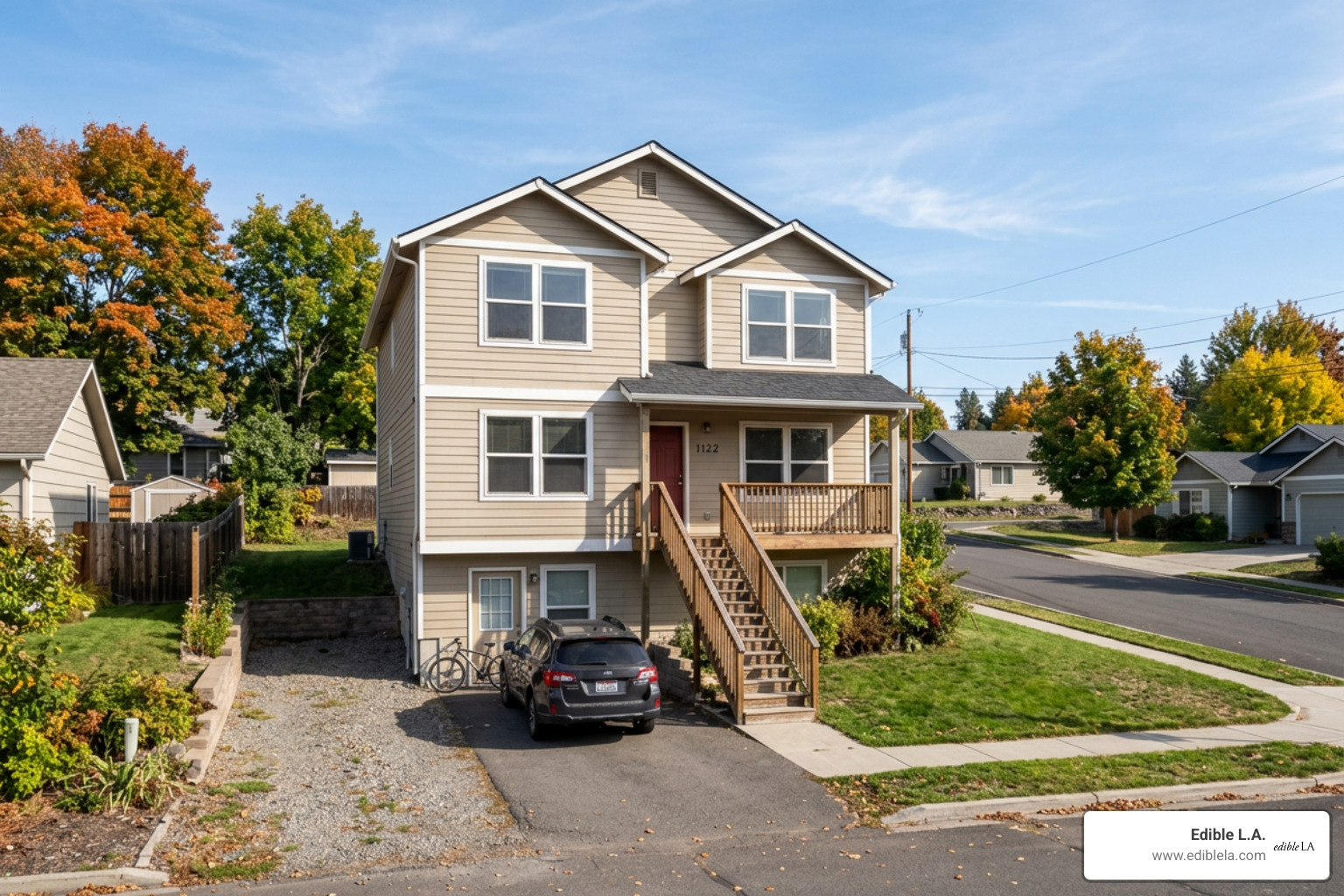
- What: Stabbing deaths of four students at an off-campus house at 1122 King Road
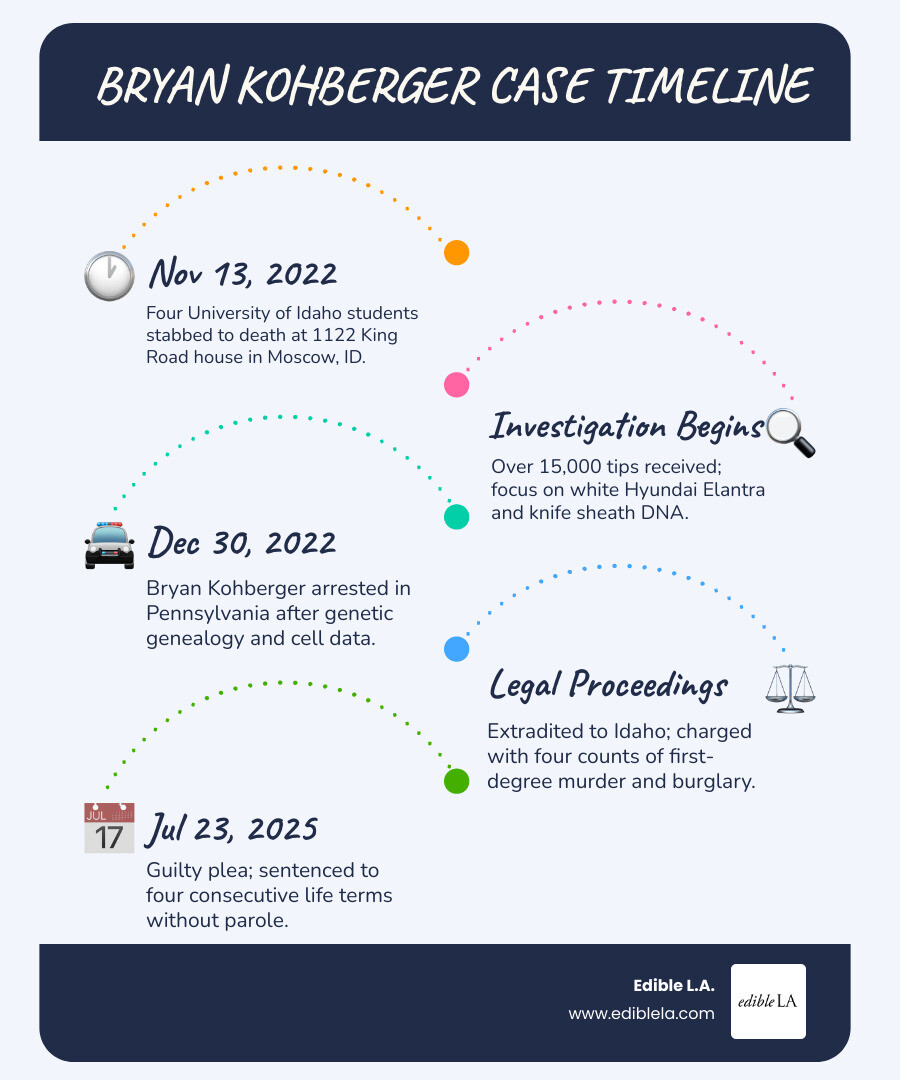
- When: Early morning hours of November 13, 2022; arrested December 30, 2022
- Verdict: Guilty plea; sentenced July 23, 2025
- Sentence: Four consecutive life terms without parole, plus 10 years for burglary and $270,000 in fines and restitution
- Motive: Unknown — Kohberger declined to speak at sentencing
In the early morning hours of November 13, 2022, four University of Idaho students were stabbed to death while they slept. The victims — Madison Mogen, Kaylee Goncalves, Xana Kernodle, and Ethan Chapin — ranged in age from 20 to 21. Two roommates survived, unharmed but deeply traumatized.
The case shocked a small college town that had not seen a murder since 2015. It became one of the most widely followed criminal investigations in recent American history, drawing over 15,000 tips to investigators within just six weeks.
Nearly three years later, the case reached its legal conclusion. But some questions — most notably, why — remain unanswered.
Bryan kohberger terminology:
The 2022 University of Idaho Murders
The tragedy unfolded at 1122 King Road, a three-story off-campus rental house known for its social atmosphere. On the night of November 12, the four victims had been enjoying a typical Saturday. Madison Mogen and Kaylee Goncalves, lifelong best friends, were seen at a local food truck before returning home. Xana Kernodle and her boyfriend, Ethan Chapin, had been at a fraternity party earlier that evening.
Between 4:00 a.m. and 4:25 a.m. on November 13, an intruder entered the home. The coroner later confirmed that the victims were likely attacked while in their beds, using a large, fixed-blade knife. The sheer brutality of the scene was staggering: Kaylee Goncalves suffered more than 20 stab wounds, while Xana Kernodle had over 50, many of which were defensive, indicating an intense struggle.
This level of violence in a quiet college town drew immediate comparisons to other tragic mass stabbings, such as the Monstruo de Liberia incident, similar previous case in Costa Rica where five students were killed in their shared home.
| Victim Name | Age | Academic Major | Background |
|---|---|---|---|
| Madison Mogen | 21 | Marketing | Senior; from Coeur d'Alene, Idaho |
| Kaylee Goncalves | 21 | General Studies | Senior; was planning a move to Texas |
| Xana Kernodle | 20 | Marketing | Junior; known for her vibrant personality |
| Ethan Chapin | 20 | Recreation, Sport & Tourism | Freshman; triplet; member of Sigma Chi |
While four lives were lost, two other roommates, Dylan Mortensen and Bethany Funke, were inside the house during the attacks. Dylan later told investigators she heard crying and someone saying, "There's someone here." She even encountered a masked man in black clothing who walked right past her as she stood in a state of "frozen shock."
The Background and Arrest of Bryan Kohberger
As the investigation intensified, the spotlight turned toward Pullman, Washington, just across the state border. This is where Bryan Kohberger was living while pursuing a PhD in criminology at Washington State University (WSU).
Peers at WSU described Bryan Kohberger as "creepy" and "intense." Newly released files reveal that female students felt so uncomfortable around him that they would shield each other or use code words. One student reported that he "aggressively stared" at women to assert dominance, tallying nine such instances in a single class. His behavior was so problematic that WSU faculty had already begun the process of terminating his Teaching Assistant (TA) position just days before the murders.
Despite his academic focus on the criminal mind—having expressed interest in "counseling high-profile criminals"—Kohberger's own actions led to his downfall. After the murders, he drove his white Hyundai Elantra across the country to his parents' home in Pennsylvania for the holidays.
On December 30, 2022, a SWAT team descended on the Pennsylvania residence. At the time of his arrest, investigators observed him wearing surgical gloves and disposing of trash into ziplock bags in the middle of the night—a clear attempt to hide his DNA. He was extradited back to Latah County, Idaho, to face four counts of first-degree murder. For a deeper dive into his transition from student to suspect, you can read Who Is Bryan Kohberger? From PhD Student to Accused Killer.
Forensic Evidence and Investigative Milestones
The evidence against Bryan Kohberger was built on a combination of old-school police work and cutting-edge science. The "smoking gun" was a tan leather Ka-Bar knife sheath found on Madison Mogen's bed. Investigators recovered a single source of male DNA from the sheath's button snap.
Using investigative genetic genealogy—a technique involving public DNA databases—the FBI was able to link that DNA to Kohberger’s father, and eventually to Bryan Kohberger himself.
Beyond DNA, the digital footprint was extensive:
- Cell Phone Pings: Kohberger's phone pinged near the King Road residence at least 12 times between June 2022 and the night of the murders.
- Surveillance: Records showed he had surveilled the house at least 23 times prior to the attack.
- The Vehicle: Security cameras captured a white Hyundai Elantra making multiple passes near the house between 3:29 a.m. and 4:04 a.m. on the night of the crime.
Interestingly, there was a significant delay in the 911 call, which wasn't placed until 11:58 a.m. the next morning. This was attributed to the surviving roommates' "frozen shock" and initial confusion, as they initially reported an "unconscious person" rather than a crime scene.
Legal Proceedings and Final Judgment
The legal battle lasted nearly three years. Latah County Prosecutor Bill Thompson initially sought the death penalty, but a plea deal was eventually reached to provide the families with certainty and avoid decades of appeals.
On July 23, 2025, Bryan Kohberger entered a guilty plea to all counts. The sentencing hearing was a somber event where the families of the victims finally had their say. The judge sentenced him to four consecutive life terms without the possibility of parole. This means he will never leave prison.
The final judgment included:
- Four fixed life terms (consecutive).
- 10 years for the burglary count.
- $270,000 in fines and restitution to the victims' families.
Following the sentencing, Kohberger was transferred to the Idaho Department of Correction to begin his term in a maximum-security facility. You can read the full report on the sentencing here: Bryan Kohberger sentenced to 4 life terms in prison without parole for Idaho murders.
The Unresolved Motive of Bryan Kohberger
Perhaps the most haunting aspect of the case is the lack of a clear motive. Bryan Kohberger "respectfully declined" to provide a statement or an explanation in court. The judge remarked that fixating on the "why" gives the defendant undue power, suggesting that we should instead focus on the lives lost.
Victims' families called him a "coward" and a "hollow vessel." While some speculated about "weird porn fetishes" or a desire to commit the "perfect crime" as a criminology student, the truth may never be fully known. One victim's aunt even offered him forgiveness, inviting him to call her from prison if he ever felt the need to explain himself.
The Final Sentencing of Bryan Kohberger
At his final appearance, Bryan Kohberger appeared gaunt and emotionless. His physical transformation during his 900 days in custody was noted by many. After the sentencing, he underwent a two-week Reception and Diagnostic (RDU) process to determine his permanent housing. Due to the high-profile nature of the case, there remains a possibility of an out-of-state transfer for his own safety.
Frequently Asked Questions about the Idaho Murders
Why did the roommates wait to call 911?
This has been one of the most debated aspects of the case. Investigators and psychologists point to a state of "frozen shock." Dylan Mortensen described seeing a masked figure but being unable to process the danger immediately. Combined with the late hour and potential intoxication common in a college environment, the roommates didn't realize the gravity of the situation until later that morning. The 11:58 a.m. call was initially for an "unconscious person" as friends had been called over to the house first.
What happened to the house on King Road?
The house at 1122 King Road was a constant reminder of the tragedy. After being gifted to the University of Idaho by the owner, the decision was made to demolish it. In December 2023, the structure was torn down to help the community move forward. In its place, the university has established the Vandal Healing Garden and Memorial, as well as scholarships in the victims' names.
Was there a connection between the suspect and victims?
To date, no concrete social or personal connection has been established between Bryan Kohberger and the four students. While rumors of social media stalking persisted, the primary evidence of a "connection" remains the 12 cell phone pings and 23 surveillance trips he made to the area in the months leading up to the murders.
Conclusion
The sentencing of Bryan Kohberger brings a sense of legal closure to a case that redefined the meaning of safety for the Moscow community. It serves as a stark reminder of the importance of acting on institutional red flags—such as the complaints filed against him at WSU—before behavior escalates into violence.
At Edible L.A., we believe in the power of storytelling to foster community healing. While our focus is usually on the vibrant food culture of Los Angeles—from the farmers' markets of Santa Monica and Beverly Hills to the hidden gems in Silverlake, Echo Park, and Culver City—we recognize that communities everywhere are built on a shared sense of security and trust. Supporting our neighbors means standing with them in times of both celebration and sorrow.