Coordinate Plane 101
Master the coordinate plane: plot points, graph functions, explore quadrants, history & real-world apps like GPS in this beginner’s guide!
What Is a Coordinate Plane (and Why Does It Matter)?
A coordinate plane is a two-dimensional flat surface formed by two number lines that cross each other at a right angle. For those of us at Edible L.A., it’s the hidden geometry behind the maps that guide us to the best seasonal flavors in Los Angeles County. One line runs horizontally (left to right). The other runs vertically (up and down). Together, they create a grid you can use to pinpoint any location—from a hidden taco stand in East L.A. to a high-end bistro in Beverly Hills—with just two numbers.
Here's the quick answer:
- What it is: A two-dimensional grid made of a horizontal x-axis and a vertical y-axis
- Where they meet: The origin, at point (0, 0)
- How points are named: As ordered pairs (x, y)
- What it divides into: Four regions called quadrants, numbered I through IV counter-clockwise
- What it's used for: Graphing points, lines, functions, maps, GPS, and navigating the L.A. food scene
You've likely seen one before — it looks like a large sheet of graph paper with a bold cross drawn through the center.
The concept dates back to 1637, when French mathematician René Descartes published the idea that changed math forever. By linking geometry to algebra through a simple grid, he gave us a tool that now powers everything from classroom graphing to the satellite navigation we use to find the freshest farmers markets in Santa Monica.
Whether you're a student plotting your first point or a culinary explorer mapping out your next weekend food crawl, the coordinate plane is the foundation it all builds on.
Anatomy of the Coordinate Plane
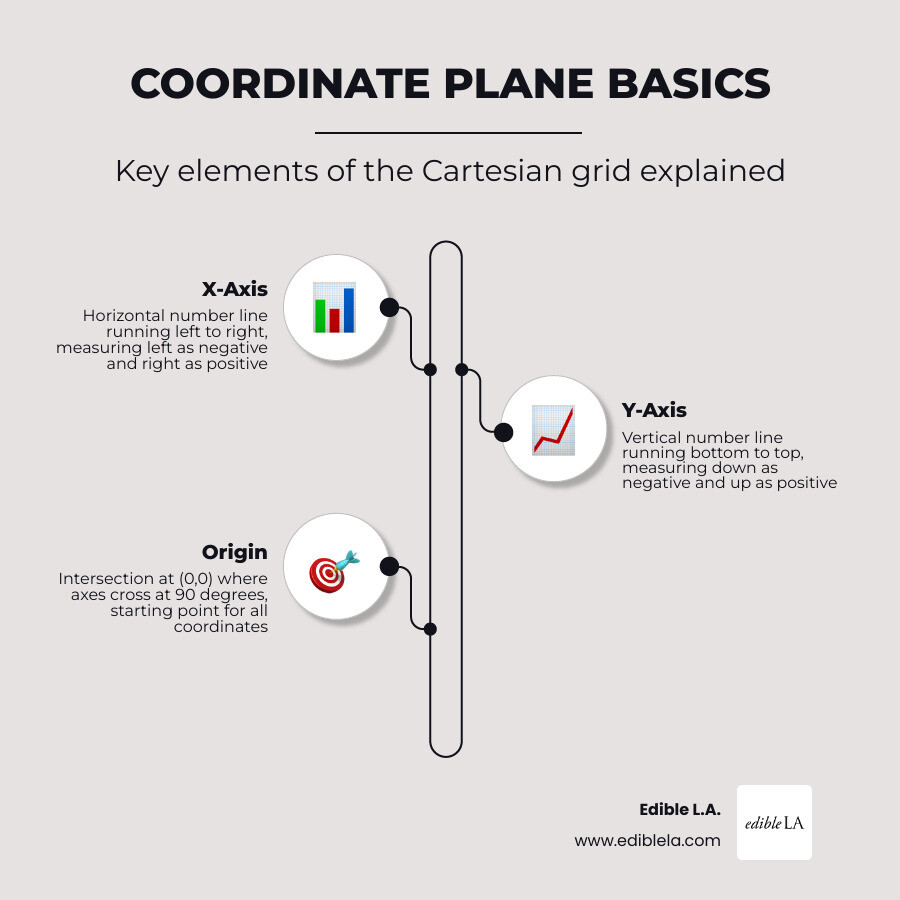
To understand the coordinate plane, we first need to look at its "skeleton." At its most basic level, the plane is constructed from two perpendicular number lines. These lines are called axes.
The horizontal line is the x-axis, and the vertical line is the y-axis. Because they meet at a 90-degree angle, we refer to this as a Cartesian orthogonal coordinate system. This intersection is the "heart" of the plane, known as the origin. The coordinates of the origin are always (0,0), representing the starting point for any measurement or movement on the grid.
In Analytic geometry, this setup allows us to describe the position of any point by its distance from these two axes. Think of it like the streets of Santa Monica or Downtown Los Angeles; to find a specific farm-to-table restaurant, you need to know how many blocks to go East/West and how many to go North/South.
The grid itself is made of grid units. Depending on the scale you need, these could represent single integers, fractions, or even miles on a map of Los Angeles County. A standard educational grid often uses 1/4 inch squares, providing a clear visual for plotting.
Understanding the Four Quadrants
When the x-axis and y-axis cross, they divide the infinite flat surface into four distinct regions called quadrants. We label these using Roman numerals (I, II, III, and IV) in a specific order: counter-clockwise, starting from the upper right.
- Quadrant I (Top Right): This is the "positive zone." Both the x and y coordinates are positive (+, +).
- Quadrant II (Top Left): Here, you’ve moved left of the origin but stayed above it. The x-coordinate is negative, but the y-coordinate remains positive (-, +).
- Quadrant III (Bottom Left): This is the "all negative" zone. You are left of and below the origin (-, -).
- Quadrant IV (Bottom Right): In this final section, you are right of the origin but below it. The x-coordinate is positive, but the y-coordinate is negative (+, -).
Understanding these sign patterns is a major shortcut. If we tell you a point is at (-5, -10), you instantly know it’s hiding in Quadrant III without even looking at a piece of paper!
Abscissa and Ordinate: The Language of Coordinates
In mathematics, we love precise names for things. While most people just say "the x number" and "the y number," the formal terms are abscissa (for x) and ordinate (for y). Together, they form Cartesian coordinates.
These are written as ordered pairs in the format (x, y). The "ordered" part is vital—the x-coordinate always comes first, followed by the y-coordinate. They follow alphabetical order (X before Y), which is a handy way to remember which is which.
In more advanced studies, such as physics or engineering, these coordinates can represent position vectors, showing not just a location, but a direction and distance from the origin.
How to Plot and Read Points
Plotting a point on a coordinate plane is a lot like following a recipe or finding a specific vendor at the Hollywood Farmers Market. You always start at the same place: the origin (0,0).
- Find the x-coordinate: If the number is positive, move that many units to the right. If it’s negative, move to the left.
- Find the y-coordinate: From your new horizontal position, move up if the number is positive or down if it’s negative.
- Mark the spot: Place a dot at the final location and label it with its Coordinates of a point or a capital letter (like Point A for an artisan bakery in Venice).
This system relies on the completeness property, which is a fancy way of saying that every single point on the plane has exactly one unique ordered pair, and every ordered pair describes exactly one point. There’s no room for ambiguity when you're trying to find that one specific food truck in a crowded lot!
Graphing Functions on a Coordinate Plane
Once you’ve mastered single points, you can start connecting them to see patterns. This is how we graph functions and linear equations. The most common method for beginners is creating a table of values.
You choose several "inputs" (the independent variables, usually represented by x) and plug them into an equation to find the "outputs" (the dependent variables, or y). For example, if your equation is y = 2x - 1, and you choose x = 1, your y will be 1. This gives you the ordered pair (1, 1).
By plotting 4 or 5 points and connecting them, you reveal the solution set of the equation. If it’s a linear equation, those points will form a perfectly straight line that extends infinitely in both directions. For those working with different systems, a Coordinate Converter can help translate between Cartesian, polar, or spherical points.
Common Mistakes and How to Avoid Them
Even experts trip up occasionally. Here are the most common "potholes" to watch out for:
- The "Great Swap": This is the #1 mistake. Students often move vertically first and horizontally second. Remember: "Walk along the hall (x) before you go up the stairs (y)." Or, think of it as finding the right street (x) before looking for the building number (y) in Downtown L.A.
- Sign Confusion: Forgetting that "left" and "down" require negative signs.
- Axis Identity Crisis: Mixing up the x-axis and y-axis. "Y" is a tall letter with a vertical stem, just like the vertical y-axis.
- The Zero Trap: Points like (5, 0) or (0, -3) live on the axes, not inside a quadrant. If a coordinate is zero, the point stays on the line!
From René Descartes to Modern GPS
The coordinate plane isn't just a classroom exercise; it’s a historical breakthrough. Before the 17th century, algebra and geometry were treated as two completely different worlds.
In 1637, René Descartes (whose Latin name was Cartesius) changed that with his work Discourse on Method. Legend has it he came up with the idea while lying in bed watching a fly crawl across the ceiling, realizing he could describe the fly's path using its distance from the walls—a bit like a chef organizing a kitchen by the distance from the prep station to the stove.
While Descartes gets the most credit, Pierre de Fermat independently discovered similar concepts around the same time, and Nicole Oresme had used primitive coordinate-like systems centuries earlier. Together, their work formed the history of mathematics foundation that led to the development of calculus.
Real-World Applications and Mapping
In Los Angeles, we are constantly using the coordinate plane, even if we don't realize it. Every time you open a map app to find a coffee shop in Echo Park or a beach spot in Malibu, you are interacting with a coordinate system.
Modern GPS technology uses a global version of this grid. Instead of x and y, it uses latitude and longitude. Latitude lines run horizontally (like the x-axis), while longitude lines run vertically (like the y-axis). These coordinates allow satellites to pinpoint your location anywhere on Earth with incredible accuracy, helping you navigate the sprawling landscape of Los Angeles County to find your next favorite meal.
Beyond navigation, the Routledge Handbook of Mapping and Cartography details how these systems are used in:
- Computer Graphics: Every pixel on your phone screen has a coordinate.
- Engineering: Designing the structural integrity of buildings in Culver City or Beverly Hills.
- Astronomy: Mapping the stars and planets in the night sky.
Advanced Extensions: 3D and Beyond
The world isn't flat, and sometimes two dimensions aren't enough. That’s where the 3D coordinate system comes in. By adding a third axis—the z-axis—we move from a flat plane into three-dimensional space.
In 3D, the axes divide space into eight regions called octants. To keep things consistent, mathematicians use the right-hand rule: if you curl the fingers of your right hand from the x-axis toward the y-axis, your thumb points in the direction of the positive z-axis.
This extension is essential for Calculus: Multivariable and physics. It helps us describe objects that are convex (curving outward like a ball) or concave (curving inward like a bowl). Whether you are studying Euclidean space or diving into Linear Algebra Done Right, the coordinate plane is the jumping-off point for understanding the complex shapes of our universe—from the structural integrity of iconic restaurants in Culver City to the 3D modeling used in modern kitchen design.
Frequently Asked Questions about the Coordinate Plane
Why is it called the Cartesian coordinate system?
It is named in honor of René Descartes. Because his name in Latin is Cartesius, the system became known as "Cartesian." His work in the 17th century was the first to successfully bridge the gap between algebra (equations) and geometry (shapes), creating the field of algebraic geometry.
What is the difference between the x-axis and the y-axis?
The x-axis is the horizontal line (left to right) and represents the independent variable or the abscissa. The y-axis is the vertical line (up and down) and represents the dependent variable or the ordinate.
How do you find the distance between two points?
To find the distance between two points, $(x1, y1)$ and $(x2, y2)$, we use the Distance Formula, which is actually just the Pythagorean Theorem in disguise: $$d = \sqrt{(x2 - x1)^2 + (y2 - y1)^2}$$ By treating the distance between the points as the hypotenuse of a right triangle, we can calculate exactly how far apart they are across the grid—useful for estimating the travel time between a Brentwood orchard and a kitchen in Hollywood.
Conclusion
The coordinate plane is more than just a math topic; it is a fundamental logic system that helps us organize the world. From the historical insights of René Descartes to the high-tech satellites powering our GPS, this simple grid of x and y allows us to navigate, build, and create with precision.
At Edible L.A., we believe that understanding your "coordinates" is the first step to exploring the vibrant local culture of Los Angeles County. Whether you're navigating the seasonal stalls of a farmers market in Silverlake or finding a hidden gem in Glassell Park, spatial logic helps us all stay connected to our community.
Ready to map out your next culinary adventure? Discover more with our seasonal produce guide and see how the seasons shift across our local landscape, one coordinate at a time.