Everything You Need to Know About Casey Anthony
The Casey Anthony Case: What You Need to Know Casey Anthony is the Florida woman acquitted in 2011 of murdering her 2-year-old daughter, Caylee Anthony, in one of the most-watched criminal trials in American history.
The Casey Anthony Case: What You Need to Know
Casey Anthony is the Florida woman acquitted in 2011 of murdering her 2-year-old daughter, Caylee Anthony, in one of the most-watched criminal trials in American history. Even in Los Angeles, from the creative hubs of Silverlake to the coastal stretches of Santa Monica, the case became a primary topic of national discourse.
Here are the key facts at a glance:
- Who: Casey Anthony, born March 19, 1986, from Orlando, Florida
- Victim: Her daughter, Caylee Marie Anthony, born August 9, 2005
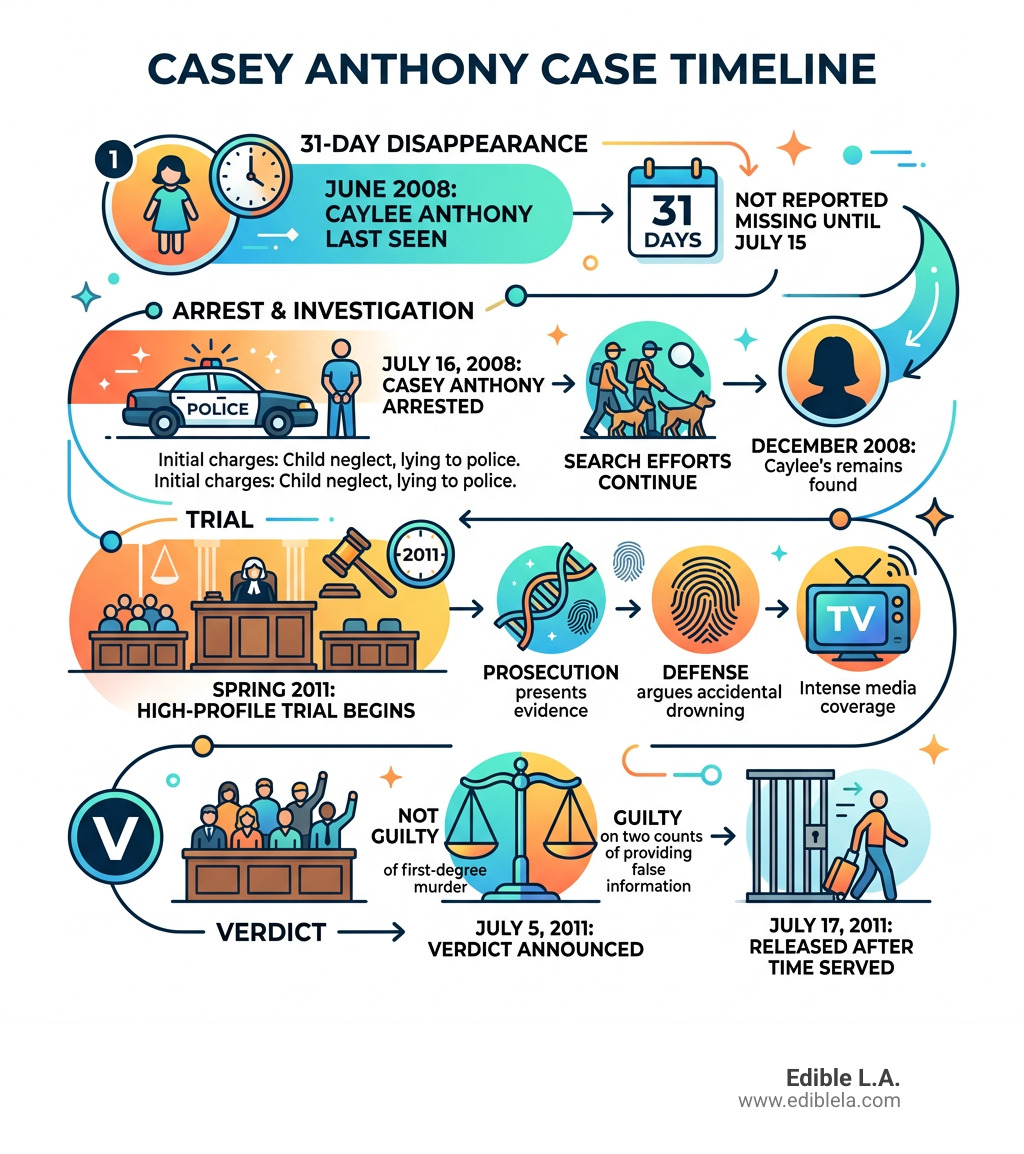
- What happened: Caylee was last seen in June 2008 and was not reported missing for 31 days
- Charges: First-degree murder, aggravated child abuse, aggravated manslaughter, and lying to police
- Verdict: Not guilty of murder; convicted on two counts of providing false information to law enforcement
- Released: July 17, 2011, after more than 1,000 days of time served
- Now: Working as a self-described legal advocate, active on TikTok and Substack as of 2025
Few criminal cases have gripped the American public the way this one did. From the offices of Downtown Los Angeles to the residential streets of Brentwood, an estimated 40 million Americans tuned in to the trial proceedings, and nearly 100 million people worldwide watched the verdict announcement. Time magazine dubbed it the "social media trial of the century."
The case raised hard questions about the justice system, media influence, and what it means when a verdict doesn't match public opinion. A USA Today/Gallup poll found that 64% of Americans believed Casey Anthony definitely or probably murdered her daughter — yet the jury disagreed.
What really happened to Caylee Anthony? And where does this story stand today? Read on for the full picture.
Similar topics to casey anthony:
The Disappearance of Caylee Anthony: A Timeline of Events
The story that would eventually consume the nation began in a quiet Orlando neighborhood in the summer of 2008. On July 15, 2008, Cindy Anthony placed a frantic 911 call that would change everything. She reported that her granddaughter, 2-year-old Caylee, had been missing for 31 days. Even more chilling was Cindy’s description of her daughter’s car: "It smells like there’s been a dead body in the damn car."
As we look back at the detailed timeline of the Caylee Anthony case, the level of deception is staggering. When police began questioning casey anthony, she spun a web of lies that sent investigators on a wild goose chase. She claimed she had left Caylee with a babysitter named Zenaida Fernandez-Gonzalez, whom she referred to as "Zanny the Nanny," at an apartment complex. She even went as far as "leading" police to Universal Studios, claiming she worked there as an event planner, only to admit at the last moment that she hadn't worked there in years.
While the search for Caylee intensified, the public learned that during the month the toddler was "missing," Casey had been seen partying, participating in a "hot body" contest at a local club, and even getting a tattoo that read Bella Vita—Italian for "Beautiful Life."

The investigation took a dark turn when Casey's Pontiac Sunfire was impounded. Both George Anthony (Casey’s father) and a cadaver dog handler testified that the trunk of the car smelled strongly of human decomposition. Despite the mounting suspicion, Casey maintained her story about the kidnapping until December 11, 2008, when a meter reader named Roy Kronk discovered skeletal remains in a wooded area near the Anthony home. The remains were later identified as Caylee’s.
The Trial of the Century: Prosecution vs. Defense
The trial began in May 2011, pitting two wildly different versions of reality against one another. The world watched as the courtroom became a stage for high-stakes legal maneuvering.
| Feature | Prosecution Theory | Defense Theory |
|---|---|---|
| Cause of Death | Murder via Chloroform and Duct Tape | Accidental Drowning in Family Pool |
| Motive | Desire for a "Beautiful Life" without parental duty | Panic and cover-up of a tragic accident |
| Key Evidence | Computer searches, trunk odor, duct tape | Alleged family dysfunction and abuse |
| Role of George Anthony | Witness for the state | Alleged accomplice in the cover-up |
The Prosecution's Case Against Casey Anthony
Lead prosecutors Jeff Ashton and Linda Drane Burdick built a case centered on Casey’s character and circumstantial forensic evidence. They argued that Casey used chloroform to render Caylee unconscious before suffocating her with duct tape. To support this, they presented evidence of a computer search for "chloroform" on the family computer (though the frequency of these searches was later debated and corrected).
The prosecution's narrative was one of a young mother who valued her freedom over her child's life. They pointed to the Bella Vita tattoo and her behavior during the 31 days Caylee was missing as proof of a lack of remorse. They characterized the duct tape found with the remains as the "murder weapon."
The Defense Strategy and Jose Baez
In a move that shocked the gallery, defense attorney Jose Baez opened the trial by claiming that Caylee had not been murdered at all. Instead, he argued she had accidentally drowned in the family’s swimming pool on June 16, 2008. According to the defense, George Anthony found the child and helped Casey cover up the death to protect her.
Baez took it a step further, alleging that Casey had been sexually abused by her father and brother, claiming this trauma led to her "pathological lying" as a defense mechanism. While George Anthony vehemently denied these claims on the stand, the defense’s goal was to create "reasonable doubt." They attacked the forensic evidence as "fantasy forensics," arguing that the state could not definitively prove how Caylee died. For more specifics, you can review these fast facts on the trial and evidence.
The Verdict and Public Reaction to Casey Anthony
On July 5, 2011, the jury delivered a verdict that stunned the world: Not Guilty of first-degree murder, aggravated child abuse, and aggravated manslaughter. Casey was convicted only on four misdemeanor counts of lying to law enforcement (two of which were later overturned).
The public reaction was immediate and visceral. Outside the Orange County Courthouse, protesters screamed in anger. Across the country, including in Los Angeles County, the news dominated every screen. From the cafes of Echo Park to the bustling neighborhoods of Culver City and the beachside community of Venice, the verdict was met with widespread disbelief. On television, HLN host Nancy Grace, who had famously dubbed Casey the "Tot Mom," expressed utter disbelief. The ratings for the verdict were astronomical; HLN saw its most-watched hour in network history, peaking at over 5.2 million viewers.
Many legal experts noted that while the public was convinced of her guilt, the prosecution had failed to provide a "smoking gun." The medical examiner had ruled the death a "homicide by undetermined means," which made it difficult for the jury to convict on a first-degree murder charge without a clear cause of death.
Life After the Trial: Where is Casey Anthony Now?
Since her release on July 17, 2011, casey anthony has lived a largely secluded life in South Florida, though she has made several attempts to "tell her story."
- Bankruptcy: In 2013, she filed for Chapter 7 bankruptcy, claiming nearly $800,000 in debt, much of it from legal fees.
- Private Investigation: In 2020, she reportedly started a private investigation business, though sources close to her have since described that venture as a "closed chapter."
- Documentary: In 2022, she appeared in the Peacock docuseries Casey Anthony: Where the Truth Lies. In the series, she doubled down on her claims against her father, providing a graphic and controversial account of the day Caylee died.
Casey Anthony on TikTok and Social Media
In a surprising move in March 2025, casey anthony re-emerged on the public stage by joining TikTok. Using the platform to rebrand herself, she announced a new career as a "legal advocate" and researcher. She also launched a Substack to share her perspective on her case and her daughter’s death. This re-emergence has sparked a new wave of controversy, as she attempts to transition from "one of the most hated women in America" to a professional in the legal field.
Where are the Key Figures Today?
The people involved in the trial have moved on in various ways:
- George and Cindy Anthony: Casey’s parents remain in Florida. Their relationship with Casey is reportedly non-existent. In 2024, they appeared in an A&E special where they took polygraph tests; Cindy stated she believes Casey "100%" knows what happened to Caylee.
- Jose Baez: The defense attorney used the high-profile win to propel his career. He now runs a successful firm with offices in Orlando and Miami and has even taught at Harvard Law.
- Judge Belvin Perry: Now retired from the bench, Perry has since stated that he believes an accidental death (perhaps involving an overdose of chloroform used as a sedative) is the most logical explanation for what happened.
- Jeff Ashton: The lead prosecutor later served as a State Attorney and has written a book about the trial.
Legal Legacy and Caylee’s Law
While the trial remains a point of frustration for many, it did lead to significant legal reform. The "Caylee’s Law" movement began as a Change.org petition that garnered nearly 1.3 million signatures.
The goal was to make it a felony for a parent or guardian to fail to report a missing child within a specific timeframe. Florida officially signed Caylee’s Law into effect in 2012, mandating that the disappearance of a child must be reported within 24 hours. Several other states have since adopted similar legislation, ensuring that no other child goes "missing" for 31 days without legal consequence for the guardians.
Frequently Asked Questions about Casey Anthony
Why was Casey Anthony found not guilty?
The jury felt that the prosecution did not meet the burden of proof for a murder conviction. Because the remains were skeletal, the medical examiner could not determine a specific cause of death. This lack of physical evidence, combined with the defense's "reasonable doubt" regarding an accidental drowning, led to the acquittal.
What is Caylee's Law and which states have it?
Caylee's Law refers to various state laws that make it a felony for a caregiver to fail to report a missing child or the death of a child in a timely manner. While it started in Florida, many other states have passed versions of the law to prevent delays in missing persons reports.
What is Casey Anthony's current career?
As of 2025, Casey Anthony has identified herself as a "legal advocate" and researcher. She uses social media platforms like TikTok and Substack to discuss legal issues and her own case history.
Conclusion
The story of casey anthony is one of the most enduring mysteries in American true crime. For us at Edible L.A., we see how certain events become woven into the fabric of our culture, much like the seasonal shifts we track in our local food scenes across Los Angeles. Whether we are exploring the culinary landscape of Beverly Hills, the hills of Malibu, or the vibrant markets of Hollywood and Venice, we recognize that our community is deeply engaged with the broader conversations that shape our society.
Whether you're exploring the nuances of the justice system or looking for the best farmers' markets in Santa Monica and Glassell Park, we're here to provide the deep dives you crave. For more on how we celebrate the best of our region, check out our More info about seasonal produce. The Casey Anthony case serves as a reminder of the power of storytelling—and the importance of seeking the truth, no matter how complex the narrative may be.