Everything You Need to Know About Pupusas
Discover pupusas: El Salvador’s national dish. Learn history, authentic recipes, fillings, and tips to make them at home!
What Are Pupusas? El Salvador's Beloved Stuffed Flatbread
Pupusas are thick, handmade corn cakes from El Salvador, stuffed with savory fillings like cheese, beans, or meat — and they are one of the most satisfying bites in all of Central American cuisine.
Quick answer:
- What they are: Thick griddle cakes made from corn masa (or rice flour), stuffed with fillings, cooked on a flat griddle
- Where they're from: El Salvador (the national dish), also traditional in Honduras
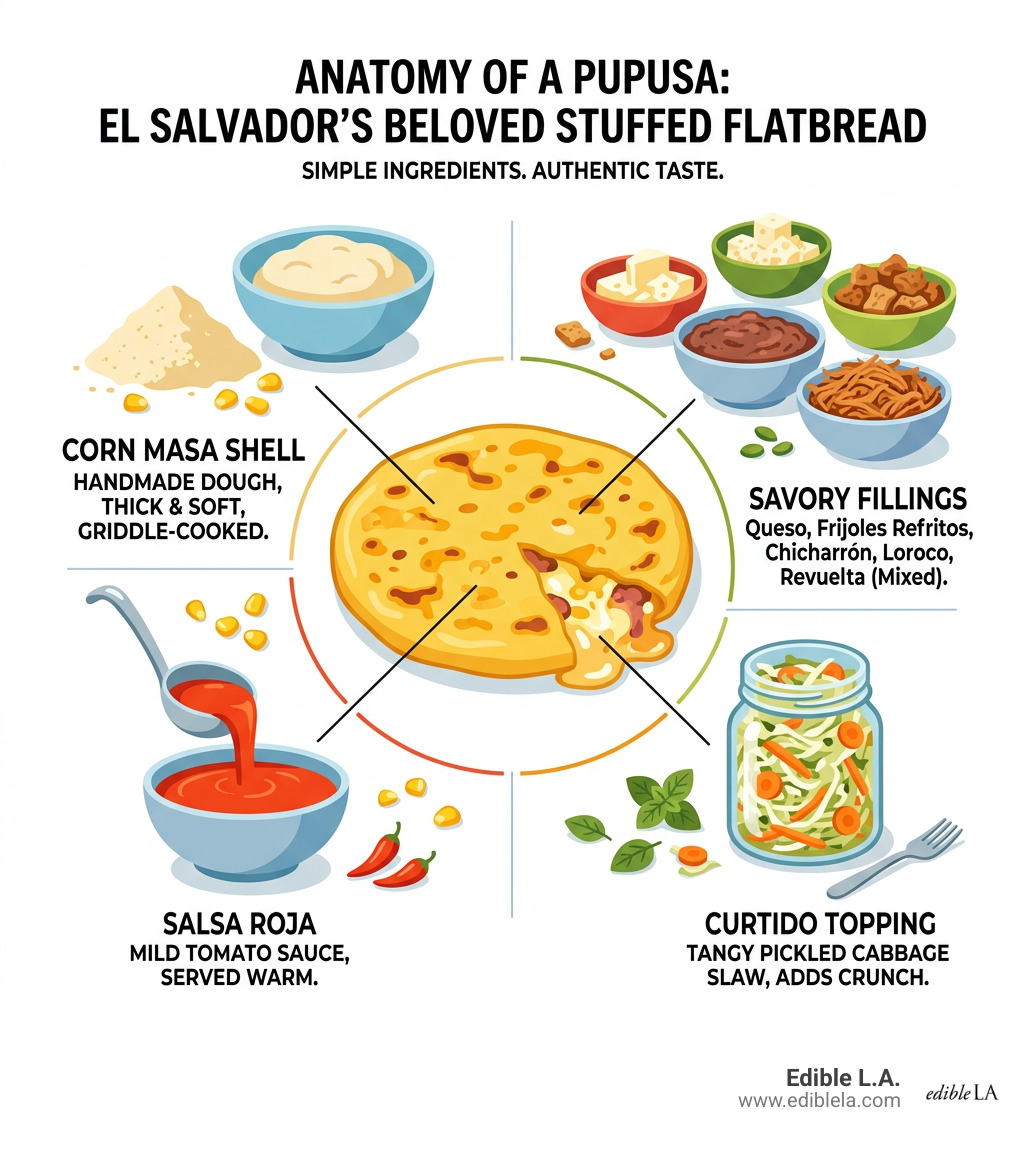
- Common fillings: Cheese, refried beans, chicharrón, loroco flowers, or all three (called revuelta)
- How they're served: Hot off the griddle, with curtido (pickled cabbage slaw) and salsa roja
- Calories: Around 350 kcal per pupusa on average
If you've ever walked through a Salvadoran neighborhood — or stopped at a pupusería in South LA — you already know the pull of that sizzling griddle smell. Crispy on the outside, soft and cheesy inside, pupusas are comfort food in its purest form.
They've been feeding people since pre-Columbian times. Today, roughly 300,000 people — mostly women — make their living preparing them. In El Salvador alone, pupuserías brought in an estimated $22 billion between 2001 and 2003. This is not just a dish. It's a cultural institution.
Whether you want to make them at home, understand their roots, or simply know what to order at your local pupusería, this guide covers everything.
The History and Origin of Pupusas
To understand the pupusa, we have to look back centuries. These stuffed griddle cakes have been sustaining people in Central America since pre-Columbian times. Anthropological evidence suggests that the Pipil tribe, indigenous to what is now El Salvador, were the original architects of this dish.
The etymology of the word is often debated. Some linguists point to the Nawat word puxahua, meaning "fluffy" or "soft," while others suggest pupusawa, which translates to "to puff up." Regardless of the linguistic roots, the first written mentions date back to the 19th century, with descriptions of similar "rellenas" appearing in historical letters.
The Pupusa War: El Salvador vs. Honduras
While both El Salvador and Honduras claim the pupusa as their own, the dispute reached a diplomatic peak during the CAFTA-DR (Central America Free Trade Agreement) negotiations in the early 2000s. In a move to protect their national heritage, El Salvador sought exclusive "denomination of origin" for the dish. Interestingly, during the 2003 talks, the Honduran negotiator eventually ceded the rights, and El Salvador was officially recognized as the home of the pupusa. You can read more about this geopolitical food fight in The Pupusa War: El Salvador vs Honduras.
Evolution and Global Impact
The dish has evolved significantly over the last century. In the 1930s, a corn shortage in the Olocuilta region led to a brilliant innovation: rice flour pupusas. These are now a beloved variation, prized for their slightly different texture and lighter color.
The Salvadoran Civil War in the 1980s caused a mass exodus, bringing Salvadoran culture and its national dish to cities across the United States. In Los Angeles, the community flourished, turning spots like Grand Central Market into hubs for authentic flavors. For a deeper look at one of our favorite local spots, check out our Deep Dive on Sarita's Pupuseria.
Today, the pupusa is a record-breaker. As of 2024, the Guinness World Record for the largest pupusa stands at a staggering 6.1 meters (20 feet) wide!

Essential Ingredients and Traditional Fillings
The beauty of the pupusa lies in its simplicity. At its core, the dough is made from masa harina—corn flour that has undergone nixtamalization (soaking in an alkaline solution). This process not only makes the corn more nutritious but also gives it that distinct, earthy flavor we love.
While a single pupusa averages about 350 calories, the nutritional profile changes based on your choice of flour and filling.
| Feature | Corn Masa Pupusa | Rice Flour Pupusa |
|---|---|---|
| Texture | Chewy, hearty, earthy | Crispy edges, lighter, soft |
| Color | Golden yellow | Bright white |
| Origin | Ancient Mesoamerica | 1930s Olocuilta (innovation) |
| Best For | Traditional chicharrón | Cheese and loroco |
Traditional Fillings for Pupusas
If you’re looking for the authentic experience, these are the "big six" fillings you’ll find in almost any pupusería:
- Quesillo: A semi-soft, salty Salvadoran cheese that melts beautifully.
- Chicharrón: Not the crispy pork rinds you might expect, but a seasoned pork paste made by grinding cooked pork with tomatoes and spices.
- Refried Beans: Usually red silk beans or black beans, blended into a smooth, thick paste.
- Loroco: The edible flower buds of a Central American vine. They have a unique, nutty, and slightly floral taste.
- Pupusa Revuelta: The crowd favorite—a mix of chicharrón, beans, and cheese.
- Ayote: Finely grated squash (similar to zucchini) mixed with cheese.
Creative and Modern Variations
In Los Angeles, our diverse food scene has pushed the boundaries of the traditional pupusa. We’ve seen everything from shrimp and carne asada fillings to spicy jalapeño and spinach versions.
For those with dietary restrictions, pupusas are a dream. Since they are made from corn or rice, they are naturally gluten-free (just be sure to check for cross-contamination). Vegan adaptations are also becoming more common, substituting the cheese with seasoned cashew creams or simply doubling up on flavorful beans and loroco.
How to Make Authentic Pupusas at Home
Making pupusas is an art form that relies heavily on "feel." If you ask a Salvadoran grandmother for a recipe, she might tell you to add water until it "feels right." For the rest of us, here is a step-by-step guide to finding that perfect consistency.
The Dough Preparation
Start by whisking 2 cups of masa harina with a pinch of salt. Gradually add warm water (about 1.5 to 2 cups). You want a dough that is soft, moist, and tacky, but not so sticky that it clings to your fingers.
The "Crack Test": Roll a small ball of dough and flatten it into a disc. If the edges crack significantly (more than 1/4 inch), your dough is too dry. Add water a teaspoon at a time until it’s supple.
The Stuffing Technique
- Oil your hands: Keep a small bowl of oil or oil-and-water nearby. Lightly coat your palms to prevent sticking.
- Form a cup: Take a golf-ball-sized piece of dough and indent the center with your thumb to create a small bowl shape.
- Add filling: Place about a tablespoon of your chosen filling into the "cup."
- Seal it up: Gently bring the edges of the dough over the filling and pinch them shut, removing any excess dough from the top.
- The Slap: Gently pat the ball between your palms, rotating it as you go, to flatten it into a 4-to-5-inch disc. If it tears, just pinch it back together—leaking cheese that browns on the griddle is actually a delicious bonus!
Cooking
Heat a cast-iron skillet or nonstick griddle over medium-high heat. You don't need much oil—just a light wipe will do. Cook the pupusas for about 3 to 5 minutes per side. You're looking for those beautiful "golden-brown" spots and a slight puffiness.
Tips for Perfect Homemade Pupusas
- Use Boiling Water: Some experts recommend using boiling water to hydrate the masa. This "superhydrates" the flour, making the dough much more tender and less likely to crack.
- The Cookie Scoop: For uniform pupusas, use a 2-ounce cookie scoop to portion out your dough balls.
- Keep it Covered: Always keep your dough and finished discs under a damp cloth while you work to prevent them from drying out.
Serving, Storing, and Reheating
A pupusa is never served alone. To eat it like a local, you need the two essential sidekicks: curtido and salsa roja.
Curtido is a lightly fermented cabbage slaw. It’s crunchy, tangy, and slightly spicy, usually seasoned with Mexican oregano and vinegar. It acts as the perfect acidic foil to the rich, cheesy pupusa.
Salsa Roja is a mild, watery tomato sauce that brings everything together.
Pro Tip: In El Salvador, pupusas are traditionally eaten with your hands. Tear off a piece of the warm cake, use it to scoop up some curtido, and enjoy. It’s also a popular breakfast item, often paired with a steaming cup of chocolate caliente (hot chocolate).
Storage and Freezing Instructions
Pupusas are fantastic for meal prep because they freeze incredibly well.
- To Freeze: Place uncooked, shaped pupusas on a baking sheet lined with parchment paper. Flash-freeze them for 20 minutes until firm, then transfer them to an airtight freezer bag. They will stay fresh for up to 4 months.
- Reheating: Do not microwave if you want to keep that crispy exterior! The best way to reheat is on a dry griddle or skillet over medium heat until warmed through.
- Air Fryer Method: For a quick fix, air fry at 400°F (200°C) for about 4 minutes, flipping halfway through. It brings back that perfect crunch.
Frequently Asked Questions about Pupusas
What is the best cheese to use for pupusas?
The gold standard is Quesillo, but it can be hard to find in every grocery store. A great hack is to mix Mozzarella (for the melt) with Monterey Jack (for flavor) and a sprinkle of Cotija or Feta to add that signature salty tang.
Can I make pupusas ahead of time?
Absolutely. You can prepare the fillings and the curtido up to a week in advance. The dough is best used within 1-2 days if kept in the fridge, but as mentioned, the assembled pupusas freeze beautifully.
Are pupusas naturally gluten-free?
Yes! Traditional pupusas made from 100% corn masa or rice flour are naturally gluten-free. However, if you are dining out, always ask if they add wheat flour to their masa or if they use shared griddles.
Conclusion
At Edible L.A., we believe that food is the ultimate storyteller. The pupusa tells a tale of resilience, from its ancient Pipil roots to its status as a global comfort food icon. Whether you’re grabbing a quick lunch at a stall in Downtown L.A. or spending a Sunday afternoon mastering the "slap" technique in your own kitchen, you’re participating in a rich, seasonal culture that we are proud to support.
Ready to explore more of what our local food scene has to offer? Check out our Seasonal Produce Guide to find the best ingredients for your next kitchen adventure. Happy cooking, and even happier eating!