The Definitive Guide to Katie Meyer Stanford Death
Discover Katie Meyer Stanford’s legacy, 2022 death, wrongful lawsuit settlement, and Katie Meyer’s Law for student mental health.
Katie Meyer Stanford: A Champion's Life, Tragic Loss, and Lasting Legacy
At Edible L.A., we are dedicated to the stories of our community: the people, the places, and the shared experiences that define Los Angeles. While our reporting focuses on food culture season by season, we also cover local Angelenos whose lives shaped conversations about wellness, leadership, and community care. Katie Meyer Stanford is a name that carries deep meaning: a story of athletic brilliance, fierce loyalty, and a tragedy that changed how California universities handle student discipline.
Here's a quick summary of who Katie Meyer was and why her story matters:
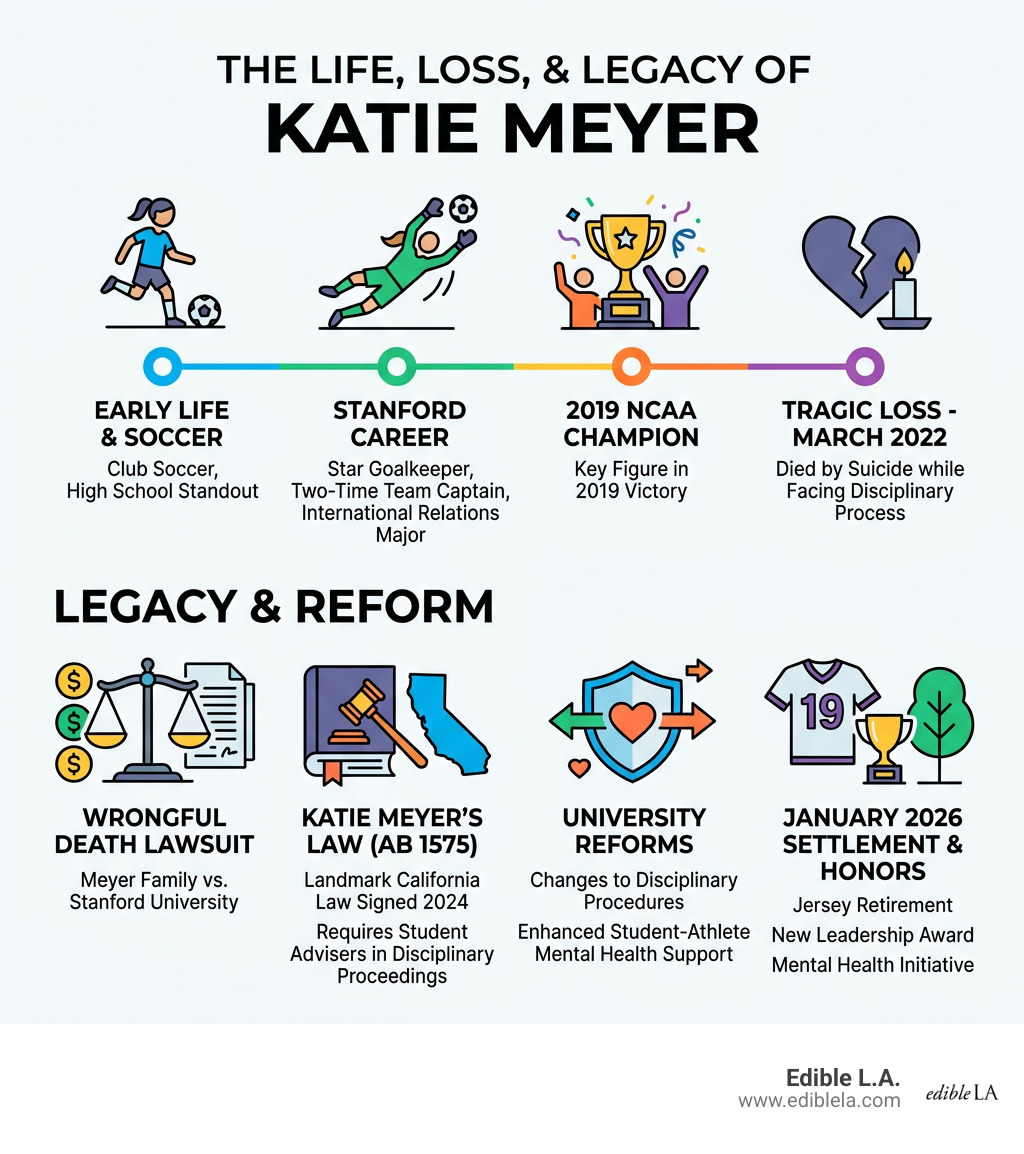
- Who she was: Katie Meyer was Stanford's star goalkeeper, two-time team captain, and a key figure in the Cardinal's 2019 NCAA Women's Soccer Championship
- What happened: She died by suicide on March 1, 2022, at age 22, while facing a university disciplinary process she found deeply stressful
- Why it matters: Her death led to a wrongful death lawsuit against Stanford, a landmark California law (Katie Meyer's Law, AB 1575), and sweeping changes to how universities treat students in disciplinary proceedings
- The settlement: In January 2026, Stanford and the Meyer family reached a settlement including jersey retirement, a new leadership award, and a student-athlete mental health initiative
- The law: Signed in 2024, Katie Meyer's Law now requires California public universities to provide students with an adviser during disciplinary proceedings
Katie was a senior majoring in International Relations who once said her academic discipline "changed my perspective on the world and the very important challenges that we need to work together to overcome." She had plans to run for President in 2036. Instead, her story became a catalyst for protecting the very students she cared so deeply about.
If you or someone you know is struggling, call or text 988 to reach the Suicide and Crisis Lifeline.
Katie meyer stanford terms at a glance:
Who Was Katie Meyer? Her Legacy at Stanford

To understand the impact of the katie meyer stanford story, we first have to look at the vibrant life of the woman behind the jersey. Born in Burbank, California, Katie was a true product of our local Southern California spirit—the same passion and dedication we celebrate in the artisans and creators across Los Angeles County. She grew up with a "larger-than-life" personality that filled every room she entered, whether it was a classroom in Palo Alto or a soccer field in front of thousands of fans.
Before she became a household name in college sports, Katie was a standout at Newbury Park High School. She wasn't just a soccer player; she was a versatile athlete who even served as the kicker for the varsity football team. Her journey to Stanford was paved with hard work and a relentless drive for excellence. At Stanford, she wasn't just a student-athlete; she was a leader. She served as a Resident Assistant (RA) and was a senior International Relations major with a minor in History.
In a 2020 Interview with Katie Meyer, her confidence was on full display. She spoke about her "educated guess" technique for penalty kicks, which involved reading a shooter’s foot placement and hip alignment. But more than technical skill, she possessed an emotional fire that made her a fan favorite. While some media outlets occasionally criticized her for her passionate, "trash-talking" celebrations, Katie defended her style as authentic sportsmanship. She believed that athletes should show true emotion, famously saying that celebrations make sports more fun and draw in wider audiences.
Her aspirations reached far beyond the pitch. Katie famously had the year 2036 picked out for her presidential campaign. Her teammates and friends described her as having "fierce loyalty," a quality that would eventually play a central role in the events leading up to her death.
Career Statistics of Katie Meyer Stanford
The numbers Katie put up during her time at Stanford are nothing short of legendary. She was a penalty kick specialist who lived for high-stakes moments. In 2019, as a redshirt freshman, she recorded a 0.26 goals-against average, which tied for the fewest goals allowed in Stanford program history for players meeting the minimum game requirements.
| Category | 2019 Season (Redshirt Freshman) | 2021 Season (Redshirt Junior) |
|---|---|---|
| Appearances | 16 (All Starts) | 20 (19 Starts) |
| Goals-Against Average | 0.26 | 0.91 |
| Save Percentage | 0.818 | 0.811 |
| Shutouts | 10 | 5 |
| Minutes Played | 1,400+ | 1,675:51 |
Over her career, Katie made 50 total appearances and recorded 20 career shutouts, ranking her eighth in Stanford history. She was a three-time Pac-12 Fall Academic Honor Roll member and a hero of the 2019 College Cup, where her two critical saves in the penalty shootout against North Carolina secured Stanford’s third national championship.
The 2022 Tragedy and the Wrongful Death Lawsuit
On March 1, 2022, the Stanford community was rocked by the news that Katie Meyer had been found dead in her residence at Crothers Hall. The cause of death was determined to be suicide. As the details emerged, a heartbreaking narrative surfaced regarding the immense stress Katie was under in the days leading up to her passing.
The tragedy was deeply tied to a university disciplinary process. In August 2021, Katie had allegedly spilled coffee on a Stanford football player. According to the lawsuit later filed by her family, Katie was defending a minor teammate who had accused the football player of sexual assault. Katie’s "fierce loyalty" led her to stand up for her teammate, an act that triggered a months-long disciplinary investigation by the university.
On the very night of her death, Stanford sent Katie a formal disciplinary notice. The family argued that the language in the notice was "threatening" and that the university’s process was "overly punitive" and lacked necessary mental health safeguards. In November 2022, the Meyer family filed a wrongful death lawsuit against the university, seeking to hold the institution accountable for what they viewed as a systemic failure to protect a student in crisis.
The Information on the Meyer family lawsuit detailed allegations that the university ignored Katie's mental state and pushed forward with a cold, bureaucratic process that left her feeling isolated and fearful for her future. Katie’s parents appeared on the Today Show shortly after her death, sharing the painful contrast between their daughter’s joyful exterior and the internal struggle she faced while navigating the university's legal machinery.
Honoring a Hero: Settlement Terms and Katie Meyer’s Law
In January 2026, a major turning point occurred when Stanford and the Meyer family announced a settlement, ending a three-year legal battle. While the monetary terms were not disclosed, the non-monetary commitments made by the university are designed to ensure that Katie’s name remains synonymous with student-athlete welfare and institutional reform.
As part of the Joint statement on settlement terms, Stanford agreed to several significant tributes:
- Jersey Retirement: The number #19, worn by Katie, has been officially retired by the Stanford women’s soccer program.
- Leadership Award: The university established the Katie Meyer Leadership Award to honor student-athletes who demonstrate the same courage and leadership Katie was known for.
- Mental Health Initiative: Stanford is launching a new initiative focused on the mental health of student-athletes in collaboration with the Meyer family and the Wu Tsai Human Performance Alliance.
Perhaps the most far-reaching outcome of this tragedy is the legislative change it sparked. In 2024, Governor Gavin Newsom signed AB 1575, officially known as Katie Meyer’s Law. This law mandates that California colleges receiving public funding must allow students to have a designated adviser present during disciplinary proceedings. This ensures that no student has to face a daunting university hearing alone, providing a layer of support that Katie did not have.
The Details on Katie Meyer's Law highlight that Stanford has also committed to adopting these principles within its own Office of Community Standards, even beyond what the law strictly requires.
Mental Health Advocacy and the Katie Meyer Stanford Legacy
Katie’s family has worked tirelessly to turn their pain into a platform for change. They founded "Katie’s Save," an organization dedicated to addressing the systemic challenges student-athletes face and advocating for better mental health resources on campuses.
Katie herself was already a voice for mental health before her passing. She had recorded the first episode of her podcast, "Be the Mentality," just weeks before her death, aiming to discuss the pressures of high-level athletics. Her story was also the subject of an ESPN documentary titled Save: The Katie Meyer Story, which brought national attention to the importance of university accountability.
For those in our community or anywhere else who may be struggling, it is vital to know that help is available. You can access Mental health crisis support at any time.
Frequently Asked Questions about Katie Meyer Stanford
What was the outcome of the Katie Meyer wrongful death lawsuit?
In January 2026, Stanford University and the Meyer family reached a settlement. The agreement included the retirement of Katie's #19 jersey, the creation of the Katie Meyer Leadership Award, and the launch of a new mental health initiative for student-athletes. While the university initially disagreed with the family's claims, the settlement represents a commitment to honoring Katie's legacy and improving student welfare.
Why was Katie Meyer facing disciplinary action from Stanford?
Katie was facing a disciplinary hearing regarding an incident in August 2021 where she allegedly spilled coffee on a Stanford football player. The lawsuit filed by her family stated that Katie was acting in defense of a teammate who had been sexually assaulted by the player. The formal notice of this disciplinary action was delivered to Katie via email on the night of her death.
What is Katie Meyer’s Law?
Katie Meyer’s Law (California AB 1575) is a piece of legislation signed in 2024. It requires California public universities to allow students to select an adviser to accompany them through the university’s disciplinary process. The law was inspired by the isolation Katie felt during her own disciplinary proceedings and aims to provide students with a necessary support system during stressful institutional investigations.
Conclusion
The story of katie meyer stanford is one that touches us deeply here at Edible L.A. While we are best known for telling Los Angeles food stories season by season, we also recognize the Angelenos whose lives influence how our communities care for one another. Katie was a daughter of Burbank, a hero of the California coast, and a young woman whose death helped spur student protections across the state.
Her legacy is no longer just about the saves she made on the soccer field; it is about the lives that may be protected through institutional reforms and increased mental health awareness her story inspired. As we look toward the future, we remember Katie Meyer not just for how she died, but for the "larger-than-life" way she lived.
For more stories rooted in Los Angeles and the people who shape our community, you can find More info about seasonal produce services and our latest journalism on our website. Let's continue to look out for one another, season by season.