Gabriel Fernandez Death 101
Discover Gabriel Fernandez’s tragic story, abusers’ fates, DCFS failures, and reforms from the shocking 2013 Palmdale case.
The Gabriel Fernandez Case: What You Need to Know
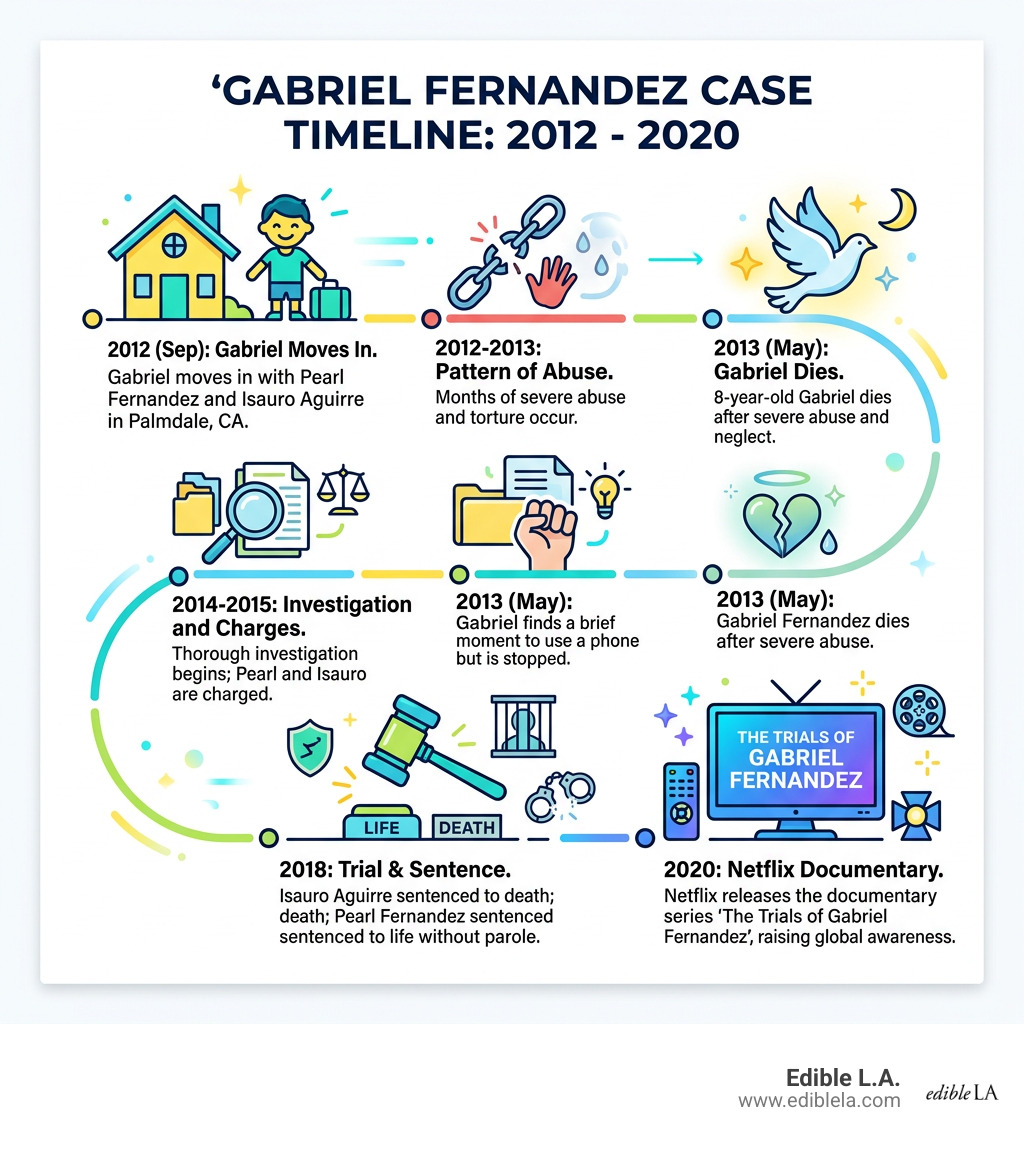
Gabriel Fernandez was an 8-year-old boy from Palmdale, California, who died on May 24, 2013, after months of severe abuse at the hands of his mother and her boyfriend.
Here are the key facts at a glance:
- Who: Gabriel Fernandez, age 8, of Palmdale, CA
- What: Tortured and murdered by his mother, Pearl Fernandez, and her boyfriend, Isauro Aguirre
- When: Abuse began around September 2012; Gabriel died May 24, 2013
- Why it matters: Over 60 complaints were filed and 8 investigations were launched — yet Gabriel was never removed from the home
- Outcome: Pearl Fernandez was sentenced to life without parole; Aguirre was sentenced to death
- Legacy: The case exposed deep failures in Los Angeles County's child welfare system and sparked major policy changes
His death was not just a family tragedy. It was a systemic failure — one that involved teachers, social workers, sheriff's deputies, and multiple agencies that each had chances to intervene.
As LA County Supervisor Zev Yaroslavsky put it at the time, the red flags were "all over the place and inexplicably ignored."
Gabriel's story forced Los Angeles — and the rest of the country — to ask hard questions about how we protect the most vulnerable children in our communities.
Common gabriel fernandez vocab:
The Life and Tragic Death of Gabriel Fernandez
To understand the magnitude of this case, we have to look at who Gabriel was before he became a headline. Born in 2005, Gabriel spent much of his young life being shuffled between relatives. For a time, he lived with his great-uncle and his partner, and later with his grandparents. Those who knew him during these years described him as a sweet, loving boy who just wanted to be part of a family.
Everything changed in 2012 when his mother, Pearl Fernandez, took custody of him. She reportedly wanted him back to claim welfare benefits, despite a long history of neglect and domestic issues. From the moment Gabriel moved into the Palmdale apartment with Pearl and her boyfriend, Isauro Aguirre, his life became a living nightmare.
On May 22, 2013, paramedics were called to the home because Gabriel had stopped breathing. He was found with a cracked skull, broken ribs, and skin covered in burns and bruises. He was declared brain dead and passed away two days later on May 24. The official cause of death was blunt force trauma, but that clinical term barely scratches the surface of the Graphic grand jury testimony of abuse that eventually came to light.
Specific Abuse Endured by Gabriel Fernandez
The details of what gabriel fernandez endured over those eight months are some of the most harrowing in the history of Los Angeles County. This wasn't just physical discipline gone wrong; it was systematic, sadistic torture.
According to testimony from his siblings and the prosecution, Gabriel was:
- Shot repeatedly with a BB gun in the face and groin.
- Burned with cigarettes across his body.
- Forced to eat cat feces, spoiled food, and his own vomit.
- Frequently gagged, bound, and locked inside a small wooden cabinet nicknamed "The Box," where he was forced to sleep and use the bathroom.
- Beaten with various objects, including a bat and a metal hanger, which resulted in knocked-out teeth and broken bones.
Perhaps most heartbreaking was the psychological torture. He was often forced to wear girls' clothing to school as a form of humiliation. Prosecutors suggested that part of Isauro Aguirre’s motive was a homophobic belief that Gabriel was gay. Despite this constant terror, Gabriel still tried to please his mother, even making her a Mother's Day card shortly before his death.
The Perpetrators: Pearl Fernandez and Isauro Aguirre
The two people responsible for Gabriel's suffering were the very people supposed to protect him. Pearl Fernandez, Gabriel's mother, had a history of mental health struggles and a low verbal comprehension level, which her defense later tried to use to mitigate her responsibility. However, the prosecution argued she was a willing participant who actively directed much of the abuse.
Isauro Aguirre, Pearl’s boyfriend, was a former security guard. While his defense tried to paint him as a "kind and compassionate" person based on previous employment, the evidence showed a man who took pleasure in the systematic destruction of a child. He was the primary physical aggressor in the final beating that ended Gabriel's life.
Legal Outcomes for the Murder of Gabriel Fernandez
The legal battle for justice was long and emotional. In February 2018, Pearl Fernandez pleaded guilty to first-degree murder with the special circumstance of murder involving torture. This plea deal allowed her to avoid the death penalty. She was sentenced to life in prison without the possibility of parole. You can find more on the Current status of Pearl Fernandez and her attempts to appeal.
Isauro Aguirre took his case to trial. In late 2017, a jury found him guilty of first-degree murder with the special circumstance of intentional murder by torture. The jury recommended the death penalty, and in June 2018, a judge sentenced him to death.
In recent years, Pearl has filed re-sentencing petitions, claiming ineffective assistance of counsel and citing changes in California murder laws. However, in 2021, Judge George G. Lomeli denied her request, stating that the murder was intentional and involved prolonged torture. While Aguirre remains on death row, California currently has a moratorium on executions, meaning his automatic appeal to the California Supreme Court is still pending.
Systemic Failures: Why the Gabriel Fernandez Case Shocked Los Angeles
What made the gabriel fernandez case a national scandal wasn't just the cruelty of the parents—it was the fact that the "safety net" designed to catch children like Gabriel had completely disintegrated. Between 2003 and 2012, there were over 60 complaints filed against Pearl Fernandez. The Department of Children and Family Services (DCFS) conducted eight separate investigations, yet they consistently deemed the allegations "unfounded."
Mandated reporters, specifically Gabriel’s teacher, Jennifer Garcia, did exactly what they were supposed to do. She called the child abuse hotline multiple times, reporting that Gabriel had come to school with a busted lip, bruises, and even marks from a BB gun. Despite these clear red flags, social workers never interviewed Gabriel privately or conducted a proper medical assessment.
Even law enforcement failed. Nine sheriff's deputies were later internally disciplined for failing to properly investigate the abuse. In one instance, a deputy was given the wrong address for a welfare check, delaying intervention by a critical week.
The Role of Social Workers in the Gabriel Fernandez Case
In an unprecedented move, the Los Angeles County District Attorney’s office filed criminal charges against four social workers involved in the case: Stefanie Rodriguez, Patricia Clement, Kevin Bom, and Gregory Merritt. They were charged with one felony count each of child abuse and falsifying public records.
The prosecution argued that the social workers minimized the evidence of Gabriel's physical suffering and allowed him to remain in a lethal environment. However, in January 2020, a state appeals court ruled that the social workers could not be held criminally liable, as they did not have the "requisite duty" or physical custody of the child. While the criminal charges were dismissed, the four were fired from their positions. This aspect of the case is a major focus of the Official Netflix documentary details, which explores the bureaucratic rot within the system.
Media Coverage and Lasting Policy Changes
The 2020 Netflix docuseries, The Trials of Gabriel Fernandez, directed by Brian Knappenberger, brought international attention back to the case. It didn't just tell Gabriel's story; it acted as an indictment of the entire Los Angeles County infrastructure. The series holds an 8.1/10 rating on IMDb, reflecting how deeply it resonated with viewers. You can check the IMDb reviews and cast info to see the public's reaction to the documentary.
In the wake of the tragedy, a "Blue Ribbon Commission" on Child Protection was established. This led to significant reforms in how LA County handles child welfare, focusing on better inter-agency coordination between the DCFS, law enforcement, and medical professionals.
Child Welfare Training: Before vs. After 2013
| Feature | Pre-2013 Protocol | Post-Reform Protocol |
|---|---|---|
| Supervision | Often handled by junior staff with high caseloads | Mandatory senior social worker oversight for high-risk cases |
| Interviews | Often done in the presence of the suspected abuser | Private, trauma-informed interviews with the child |
| Training | Classroom-heavy, theoretical | Real-life scenario simulations and field mentorship |
| Reporting | Fragmented communication between agencies | Integrated data sharing between DCFS and Sheriff's Dept |
Lessons Learned from the Gabriel Tragedy
The most painful lesson from the gabriel fernandez case is that silence is often a death sentence. The case taught Los Angeles that "unfounded" investigations need more scrutiny, especially when multiple reports are coming from the same source, like a teacher.
Tragically, the system didn't learn fast enough for everyone. In 2018, 10-year-old Anthony Avalos died in a very similar manner in the same region, despite multiple reports of abuse. This served as a grim reminder that policy changes on paper must be backed by relentless community vigilance and executive accountability. We've learned that social workers need better support and lower caseloads to actually see the children they are assigned to protect.
Frequently Asked Questions about Gabriel Fernandez
What happened to the social workers involved in the case?
The four social workers—Stefanie Rodriguez, Patricia Clement, Kevin Bom, and Gregory Merritt—were fired by the county. While they were initially charged with felonies for their roles in the case, those charges were dismissed by a California appeals court in 2020. The court found that they did not meet the legal definition of having "custody" of the child necessary for a criminal child abuse conviction.
Where are Pearl Fernandez and Isauro Aguirre now?
Pearl Fernandez is serving her life sentence at the Central California Women's Facility in Chowchilla. Isauro Aguirre is on death row at San Quentin State Prison. Because of California's current moratorium on the death penalty, he remains incarcerated while his legal appeals move through the system.
How did the Netflix documentary influence public perception?
The Trials of Gabriel Fernandez was instrumental in moving the conversation from "evil parents" to "systemic failure." It highlighted how bureaucracy, lack of funding, and poor communication between L.A. agencies created a environment where a child could be tortured for months without being rescued. It sparked a global wave of advocacy for child welfare reform.
Conclusion
At Edible L.A., we believe that a healthy community starts with the safety and well-being of its children. Gabriel’s story is a heavy one, but it is a necessary part of our city’s history. It reminds us that being a good neighbor means looking out for the most vulnerable among us—whether that’s supporting local schools or being the one who speaks up when something doesn't look right.
We can all play a part in fostering a safer Los Angeles. Whether you are in Echo Park, Silverlake, or Downtown, staying informed and involved in local advocacy is key. For those looking to support the community more directly, you can find More info about local community resources on our site. Let’s make sure that the legacy of gabriel fernandez is one of lasting change and a commitment to never letting a child fall through the cracks again.