The Ultimate Guide to Gimit
Discover Gimit’s game-changing mechanics, modes, and tips. Master gamified learning, boost engagement, and scale your classroom success!
What Is Gimit (Gimkit) and Why Teachers Love It
Gimit -- more precisely known as Gimkit -- is a gamified learning platform where students answer questions, earn virtual cash, and spend it on upgrades to outperform their classmates.
Because Edible L.A. primarily covers Los Angeles food culture season by season, this topic is outside our core beat. Still, L.A. classrooms are part of the local community ecosystem we care about, and teachers often use tools like Gimkit to teach everything from nutrition basics to local agriculture vocabulary.
Here's a quick snapshot of what it is:
- Creator: Josh Feinsilber, who built it as a high school project
- How it works: Answer questions -> earn in-game cash -> buy upgrades and powerups
- Who it's for: Students and teachers, K-12 classrooms and beyond
- Standout features: 10+ game modes, homework assignments with auto-grading, student-created question sets via KitCollab
- Growth: Went from a few thousand users to over 90,000 in 2018 alone
The idea came from a simple, personal place. Josh noticed that games kept him engaged in school when little else did. So he built one -- and it worked for thousands of other students too.
What makes Gimkit different from a typical quiz tool is its economy. Students don't just answer and move on. They think strategically about how to spend their earnings, which keeps them coming back to the questions again and again -- building real mastery along the way.
Whether you're a teacher looking for a fresh way to review material, or a student who's tired of boring flashcards, Gimkit brings something genuinely different to the classroom.
Terms related to gimit:
Understanding the Core Mechanics of Gimit
At its heart, gimit functions as a live learning game show. Unlike traditional quizzes where the goal is simply to get the highest percentage of correct answers, this platform introduces a sophisticated economic layer that mirrors real-world resource management.
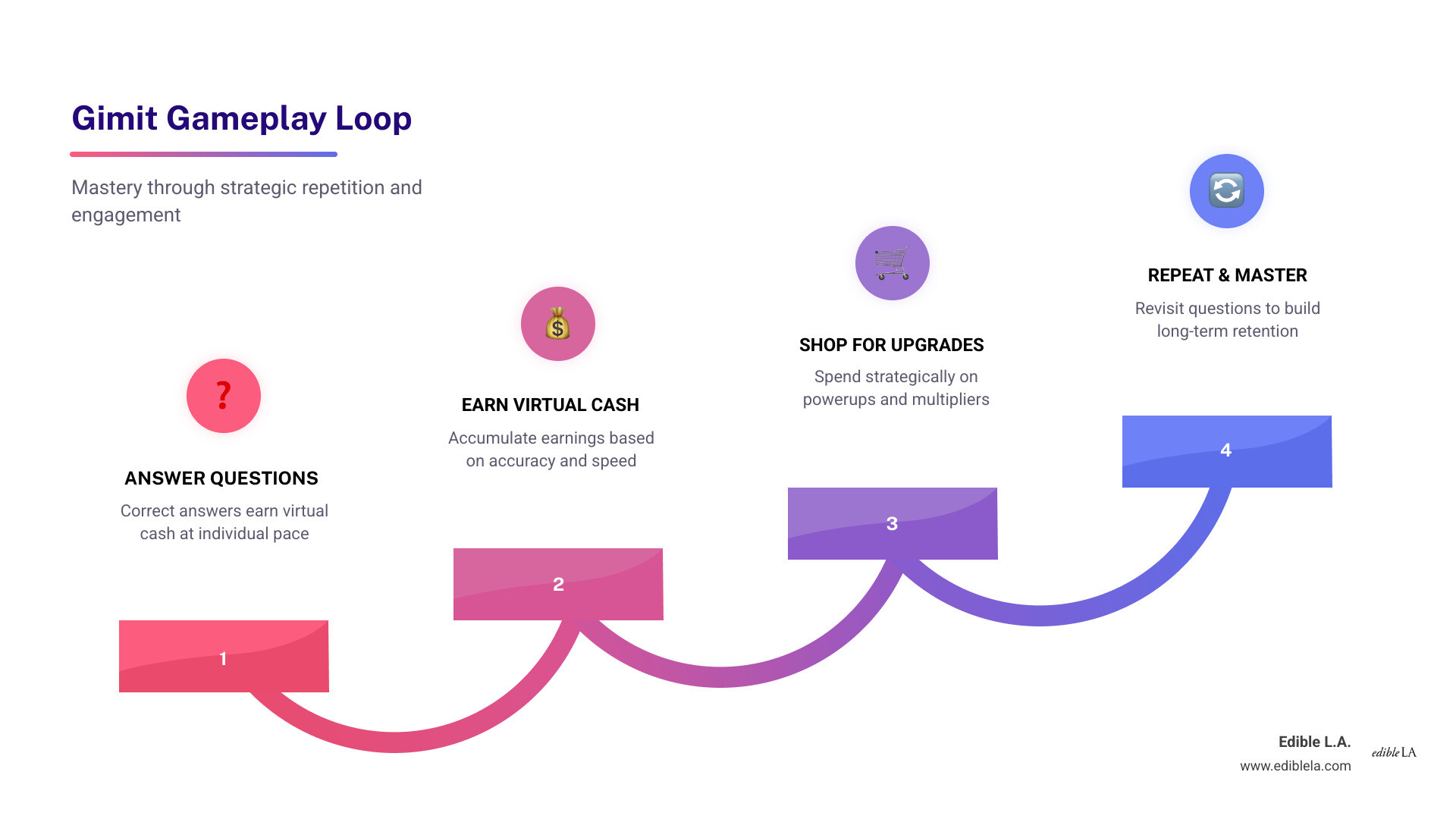
The loop is brilliantly simple:
- Answer Questions: Students work through a "Kit" (a set of questions) at their own pace on their own devices.
- Earn Virtual Cash: Each correct answer adds money to the student's digital wallet.
- Shop for Upgrades: Students visit the in-game shop to buy "Multipliers," "Insurance" (to lose less money on wrong answers), or "Money per Question" increases.
With millions of possible combinations for upgrades and powerups, no two games ever feel the same. This strategic depth is what separates it from other classroom tools. You can find more about the live experience at Gimkit - live learning game show.
How the Gimit Gameplay Loop Drives Mastery
The genius of gimit lies in its ability to encourage "repeated exposure." In a standard 10-question quiz, a student sees each question once. In a 10-minute game of gimit, a student might see those same 10 questions five or six times each.
Because students want to earn more cash to buy that next big upgrade, they are motivated to learn the correct answers quickly. This individual pacing allows faster students to fly through content while giving others the time they need to achieve mastery without feeling the pressure of a ticking clock shared by the whole class. You can see how the company has grown this vision on Gimkit - LinkedIn.
Addressing Wealth Inequality in Game Design
One of the unique challenges Josh Feinsilber faced during development was "wealth inequality." In early versions, the top students would earn so much money so quickly that those in last place felt they could never catch up.
To solve this, gimit introduced Team Mode. In this mode, students still earn money and buy their own individual upgrades, but their total balances are pooled together. This encourages student collaboration and ensures that every correct answer contributes to a collective goal.
Josh often uses a "Mario Kart strategy" analogy -- designing the game so that even those in the back have "powerups" or mechanics that keep the finish line within reach. This keeps engagement high for the entire class, not just the academic leaders.
Key Features and Collaborative Game Modes
The platform has expanded far beyond a simple quiz. Today, it offers over 10 unique game modes, including immersive 2D environments where students move characters around a map to complete tasks and answer questions.
One of the most powerful features is KitCollab. Instead of the teacher doing all the work, students contribute to the lesson planning. Students submit their own questions in real-time, the teacher gives a quick approval, and the class plays a game using the very questions the students just wrote.
Note: the name "GHITM" (sometimes confused with gimit in search results) is a biological transmembrane protein, not a classroom tool. While Scientific research on mitochondrial morphology and GHITM is fascinating for biology students, it is unrelated to Gimkit itself.
Assigning Gimit for Homework and Assessments
Gimit addresses busy teacher schedules by offering "Assignments." Teachers can set a "cash goal" for students to reach at home.
- Asynchronous Play: Students complete the kit whenever they have time.
- Automatic Grading: The platform tracks progress and provides a grade based on the cash goal reached.
- Instant Feedback: Students know immediately if they are right or wrong, allowing for self-correction.
This turns a chore into a challenge that students actually enjoy. More details on setting these up can be found at Gimkit - live learning game show.
Advanced Tools and App Assistance
For those looking to dive deeper, the platform offers "Cosmetics" -- fun visual items like "Gims" (characters) and trails that students can earn to customize their experience. This adds an extra layer of motivation.
Teachers can also:
- Import Flashcards: Quickly pull in existing sets from other platforms.
- Photo Integration: Add visual cues to questions to help diverse learners.
- Group Organization: Manage different class periods with ease.
The Evolution and Growth of the Platform
The story of gimit is one of explosive growth. In 2018, the platform saw a 500% month-over-month increase in usage during the spring. By the end of that year, the user base had grown from a few thousand to over 90,000.
This rapid scaling taught the team valuable lessons. They realized that stability is more important than speed. While it's tempting to ship new features every week, ensuring the servers don't crash when large numbers of students log in at once became the priority.
Just as a perfectly balanced ina-garten-pomegranate-gimlets recipe requires the right proportions, a successful educational tool requires a balance of fun and function.
Lessons Learned from Rapid Scaling
Josh Feinsilber's 2018 "Year in Review" highlighted the importance of user feedback. He moved away from announcing release dates early to avoid the stress of buggy launches (like the infamous version 3.0).
One fun fact: Josh was obsessed with dashboard gradients in 2017, which led to a complete design overhaul to make the platform look as modern as the games students play at home. He learned that "perfect" is the enemy of "done," and that shipping a solid product and iterating based on teacher interviews is the best path to success.
Getting Started: A Teachers Guide to Success
Getting your first game of gimit running is surprisingly simple.
- Sign Up: Create an account (you can start for free!).
- Create a Kit: Type in your questions or import them from a CSV or flashcard set.
- Host: Click "Play Live," choose a game mode (like "Classic" or "Trust No One"), and give the join code to your students.
Free vs. Pro Features
| Feature | Gimkit Basic (Free) | Gimkit Pro |
|---|---|---|
| Game Modes | Limited selection | All 10+ modes |
| Kit Creation | Unlimited | Unlimited |
| Assignments | Basic | Advanced tracking |
| Cosmetics | Limited | Full access |
Target Audience and Grade Level Versatility
While it started as a high school project, gimit is used across all age groups.
- Elementary: Focuses on simple recall and the excitement of earning "money."
- Middle School: Students begin to master the complex strategy of powerup combinations.
- High School: Used for deep mastery and student-led review through KitCollab.
The platform adapts to the maturity and competitive nature of your specific classroom. More info is available at Gimkit - live learning game show.
Frequently Asked Questions about Gimit
Who created the platform and why?
Gimit was created by Josh Feinsilber while he was still a high school student. He felt that classroom games were the only thing that truly made him feel engaged in his education, so he set out to build a tool that felt more like a "real" game and less like a digital worksheet.
How does KitCollab involve students in lesson planning?
KitCollab allows students to join a "session" before the game starts. They write their own questions and answers. The teacher sees these on their screen and can "Accept" or "Reject" them. Once enough questions are gathered, the class plays a game using the content they just created. This shifts students from passive consumers to active creators.
What are the differences between the free and pro versions?
The free version allows you to create unlimited kits and play basic game modes. The Pro version (Gimkit Pro) unlocks all game modes -- including the popular 2D "Among Us" style modes -- and provides more robust data for homework assignments. Many teachers find the Pro version pays for itself in the time saved on grading.
Conclusion
At Edible L.A., we believe in the power of local community and innovation -- whether that's a new urban garden in Echo Park or a classroom tool that helps L.A. educators keep students engaged. While gimit is not a food story, learning tools can shape how students understand topics that matter to our coverage, like seasonal eating, farmers markets, and where food comes from.
Educational innovation isn't just about technology; it's about connecting with students where they are.
For more stories on local culture and sustainable living, explore our guides on farms and gardens.