How to Boil Eggs Perfectly with 3 Easy Changes
Master how long to boil eggs perfectly: timings for jammy, soft, hard; 3 easy changes; peeling tips & science for flawless results every time.
How Long to Boil Eggs: Quick Answer Guide
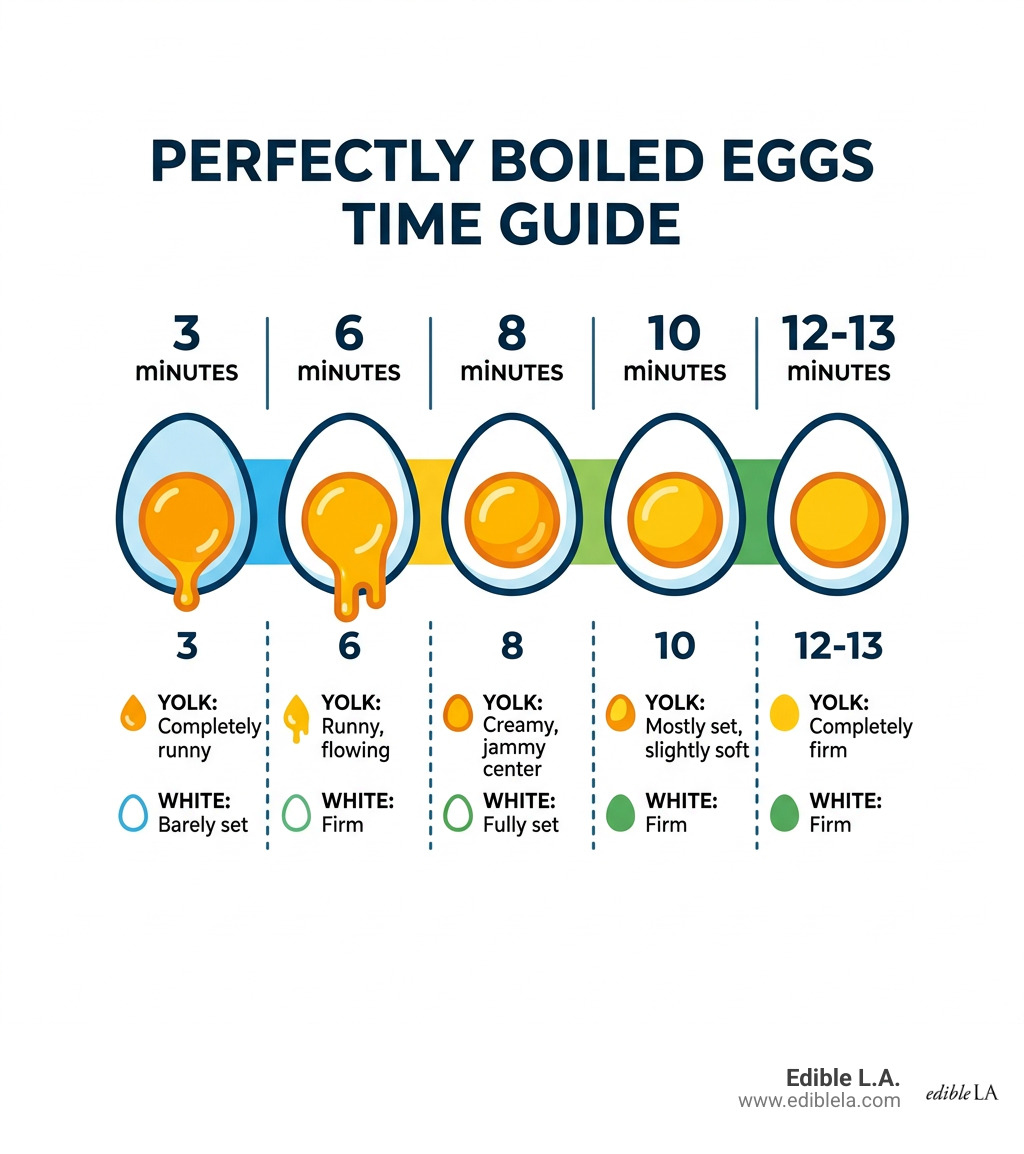
How long to boil eggs depends on how you like your yolk. Here's a fast reference for large eggs dropped into already-boiling water:
| Doneness | Time | Yolk Texture | White Texture |
|---|---|---|---|
| Dippy (soft dip) | 3 min | Completely runny | Barely set |
| Runny | 6 min | Runny, flowing | Firm |
| Jammy (soft-boiled) | 8 min | Creamy, jammy center | Fully set |
| Classic hard-boiled | 10 min | Mostly set, slightly soft | Firm |
| Fully hard-boiled | 12-13 min | Completely firm | Firm |
Note: Times above are for large eggs (50-55g) started from the fridge in already-boiling water.
Getting a perfect boiled egg sounds simple. But anyone who has bitten into a chalky, grey-ringed yolk — or fought to peel a hard-boiled egg that came out looking like a cratered moon — knows the details really matter.
The frustrating part? Most recipes online give you a method, but not the why behind it. So when something goes wrong, you're left guessing.
The good news: just three small changes to how you boil eggs make a dramatic difference — in texture, in peeling ease, and in consistency. Whether you're making jammy eggs for a Nicoise salad, creamy hard-boiled eggs for deviled eggs at a party, or a quick grab-and-go snack for the week, this guide covers everything you need.
Related content about how long to boil eggs:
The Science of Timing: How Long to Boil Eggs for Every Style
At Edible L.A., we believe that even the simplest ingredients deserve culinary precision. Whether you are sourcing your eggs from a backyard coop in Silverlake or a farmers' market in Santa Monica, understanding the science of heat transfer is the first step to mastery.
When we talk about how long to boil eggs, we are really talking about the coagulation of proteins. Egg whites (albumen) begin to set at a lower temperature than yolks. This is why you can achieve a firm white with a liquid center. However, once you cross the 12-minute mark, you enter the "danger zone" of overcooking.
The Sulfur-Iron Reaction and the Dreaded Green Ring
Have you ever sliced into a hard-boiled egg only to find a greenish-grey halo around the yolk? This isn't just an aesthetic issue; it’s a sign of overcooking. This reaction occurs when the sulfur in the egg whites reacts with the iron in the yolks. This typically happens when eggs are boiled for too long or at too high a temperature. To prevent this, we must control the duration and provide an immediate "thermal shock" in an ice bath to stop the cooking process instantly.
Safety First: USDA Guidelines
While many of us love a "jammy" egg, the USDA recommends cooking hard-boiled eggs a bit longer to ensure foodborne pathogens are eliminated. Their suggested times are 12 minutes for medium eggs, 15 minutes for large, and 18 minutes for extra-large. However, for most healthy adults, the culinary "sweet spot" of 10–12 minutes for a large egg provides a safe, creamy, and delicious result without the rubbery texture that comes from the USDA's more conservative timings.
Adjusting how long to boil eggs by size
Not all eggs are created equal. In the culinary world, "large" is the standard, but you might find yourself with a carton of jumbo eggs from a local Glassell Park vendor.
- Medium Eggs: Subtract 1 minute from the standard times.
- Large Eggs (The Standard): Use the 6, 8, 10, 12-minute rule.
- Extra-Large Eggs: Add 30 to 60 seconds to the timer.
- Jumbo Eggs: Add at least 1 to 2 minutes to ensure the heat reaches the center of the larger mass.
High altitude adjustments for how long to boil eggs
If you’re boiling eggs in the higher elevations of Los Angeles County, such as the foothills or mountains, physics is working against you. At higher altitudes, atmospheric pressure is lower, which means water boils at a lower temperature.
To compensate for the lower boiling point, you need to increase your cooking time. A good rule of thumb is to add 1 minute of cooking time for every 1,000 feet you are above 3,000 feet. If you are above 10,000 feet, traditional boiling becomes nearly impossible as the water temperature isn't high enough to coagulate the proteins effectively!
The 3 Easy Changes for Perfect Results
We’ve tested countless methods, from cold-start to steaming, and we’ve narrowed it down to three fundamental changes that will change your egg game forever.
Change 1: The Boiling Water Start
The old-school method suggests starting eggs in cold water and bringing them to a boil together. We recommend against this. Why? Because starting with cold water makes the egg membrane bond to the shell, leading to those frustrating "craters" when you peel.
Instead, bring your water to a boil first, then gently lower your fridge-cold eggs into the water. This "thermal shock" causes the egg white to contract away from the membrane, making the shell slide off later like a dream.
Change 2: The Gentle Simmer
Once your eggs are in the water, don't let them rattle around in a violent, rolling boil. This is the leading cause of cracked shells.
The Fix: As soon as the eggs are in, reduce the heat to a gentle simmer. You want to see bubbles, but you don't want the eggs performing acrobatics. This ensures the whites stay tender rather than turning into rubber.
Change 3: The 15-Minute Ice Bath
The cooking doesn't stop when you turn off the stove. Residual heat will continue to cook the yolk, leading to that green ring.
The Fix: Prepare a bowl with half ice and half water. The moment the timer dings, move the eggs into the ice bath. Let them sit there for at least 10–15 minutes. This not only stops the cooking but also further shrinks the egg inside the shell, creating a tiny gap that makes peeling effortless.
Preventing cracks and craters
To avoid the heartbreak of a cracked egg, follow these simple rules:
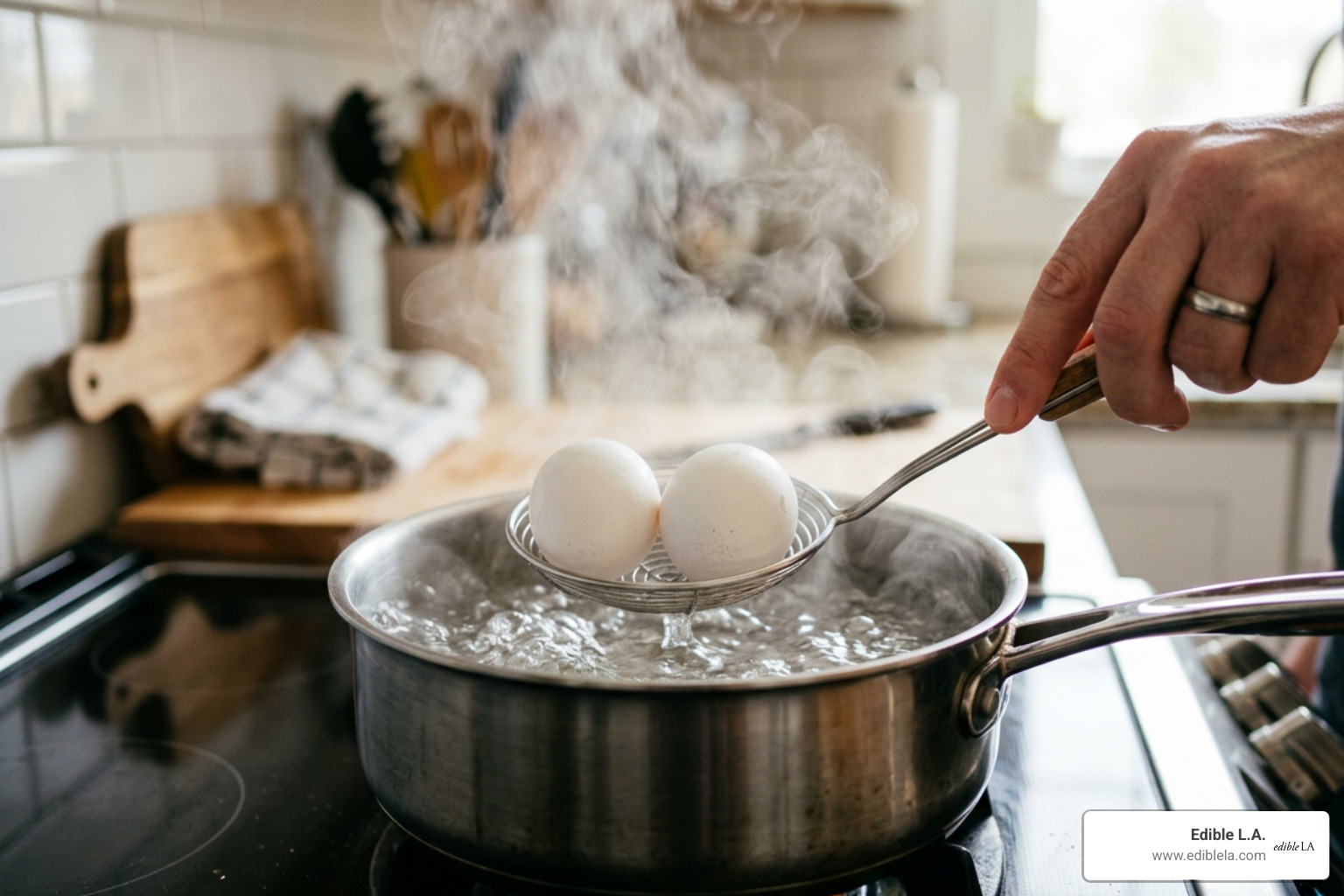
- Use a Slotted Spoon: Never drop eggs into the pot by hand. Gently nestle them onto the bottom.
- Single Layer Only: Don't stack eggs. If you're making a large batch for a party in Beverly Hills, use a wider pot so every egg has its own space on the floor of the pan.
- Room Temperature vs. Cold: While we prefer the boiling start with cold eggs for peeling ease, some chefs prefer letting eggs sit out for 20 minutes to take the chill off, reducing the risk of the shell cracking from the temperature jump. If you do this, subtract 30 seconds from your boiling time.
Foolproof Peeling and Storage Techniques
There is nothing more satisfying than a shell that comes off in one or two large pieces. To achieve this, we look at the anatomy of the egg. Every egg has a small air pocket at the "fat" or broad end.
The "Desert Landscape" Technique
Once your eggs have finished their ice bath, tap the broad end on the counter to crack the air pocket. Then, gently roll the egg under your palm with light pressure until the entire surface is covered in a web of cracks — we like to call this the "desert landscape" look.
Pro Tip: Peel the egg under a thin stream of cool running water or submerged in the ice bath. The water gets under the membrane and helps lubricate the shell, allowing it to slip right off. For more on this, check out our guide on hard-boiled-eggs.
Storing your batch
If you’re meal-prepping for a busy week in Downtown Los Angeles or Culver City, boiling a dozen eggs at once is a lifesaver.
- In-Shell: Hard-boiled eggs kept in their shells can stay fresh in the fridge for up to seven days. Keep them in an airtight container or back in the original carton to prevent them from absorbing fridge odors.
- Peeled: If you’ve already peeled them, they should be eaten within 24 hours. Store them in a bowl of cold water (changed daily) or wrapped in a damp paper towel in a sealed container.
- Safety Note: According to the American Egg Board, you should never leave boiled eggs out at room temperature for more than two hours.
Beyond the Pot: Alternative Cooking Methods
While traditional boiling is our go-to, modern kitchen gadgets offer some interesting alternatives.
Steaming (The Professional Choice)
Many pro chefs prefer steaming over boiling. By placing eggs in a steamer basket over an inch of boiling water, you cook them with the same "thermal shock" as boiling but with less turbulence. This is arguably the best method for preventing cracks.
- Soft-boiled: 6 minutes
- Hard-boiled: 12 minutes
The Instant Pot (Pressure Cooker)
The "5-5-5" method is famous for a reason: 5 minutes at high pressure, 5 minutes of natural release, and 5 minutes in an ice bath. This method is incredibly consistent and makes eggs very easy to peel, though some find the whites can become slightly tougher than stovetop methods.
Baking in a Muffin Tin
You might see "oven-baked eggs" trending on social media. While convenient for massive batches, our tests show this is the least desirable method. Baking often results in rubbery whites and brown "scorch" marks on the shells and whites. If you must do it, 350°F for 30 minutes is the standard, but we’d stick to the stovetop for better quality.
Frequently Asked Questions about Boiling Eggs
Why is there a green ring around my yolk?
As we mentioned earlier, this is a chemical reaction between sulfur and iron caused by overcooking. If you see this, it means you either left the eggs in the hot water too long or didn't cool them fast enough in an ice bath. They are still safe to eat, but the texture will be a bit dry and chalky.
Do fresh eggs peel differently than older eggs?
Yes! This is one of the few times in cooking where "older" might be better. Very fresh eggs (like those you might get from a farm in Malibu) have a lower pH, which causes the membrane to stick tightly to the shell. As an egg ages (7–10 days in the fridge), the pH rises and the air cell at the fat end expands, making the shell much easier to remove. If you have farm-fresh eggs, steaming them is often more effective than boiling for a clean peel.
How many eggs can I boil at once?
You can boil as many as will fit in a single layer at the bottom of your pot. If you overcrowd the pan, the water temperature will drop too significantly when you add the eggs, throwing off your timing. For a standard 18cm saucepan, 6 to 8 eggs is usually the limit for a consistent result.
Conclusion
Mastering the art of the boiled egg is a fundamental skill that opens the door to a world of L.A. flavors. From a protein-packed snack after a hike in Griffith Park to the centerpiece of a sophisticated deviled egg platter for a Hollywood dinner party, the humble egg is a seasonal workhorse.
By making these three easy changes—the boiling start, the gentle simmer, and the dedicated ice bath—you’ll never have to worry about grey yolks or mangled whites again. We invite you to explore our seasonal-recipes to find more ways to use your perfectly boiled eggs, supporting our local food culture one delicious bite at a time.