A Comprehensive Guide to Arepa
Master the art of arepa: history, recipes, fillings, variations & tips for perfect Venezuelan-Colombian staples.
What Is an Arepa? Your Quick Guide to This Iconic Corn Cake
An arepa is a round, flat corn cake made from precooked white or yellow cornmeal, water, and salt. It is a staple food in Venezuela and Colombia, eaten at any time of day — breakfast, lunch, or dinner.
Quick facts about arepas:
- What it is: A thick, unleavened corn patty, grilled, baked, or fried
- Main ingredient: Precooked cornmeal (masarepa), not regular cornmeal or polenta
- Origin: Pre-Columbian South America, primarily Venezuela and Colombia
- How it's eaten: Split open and filled, or eaten plain with butter and cheese
- Naturally gluten-free: Yes — 100% corn-based
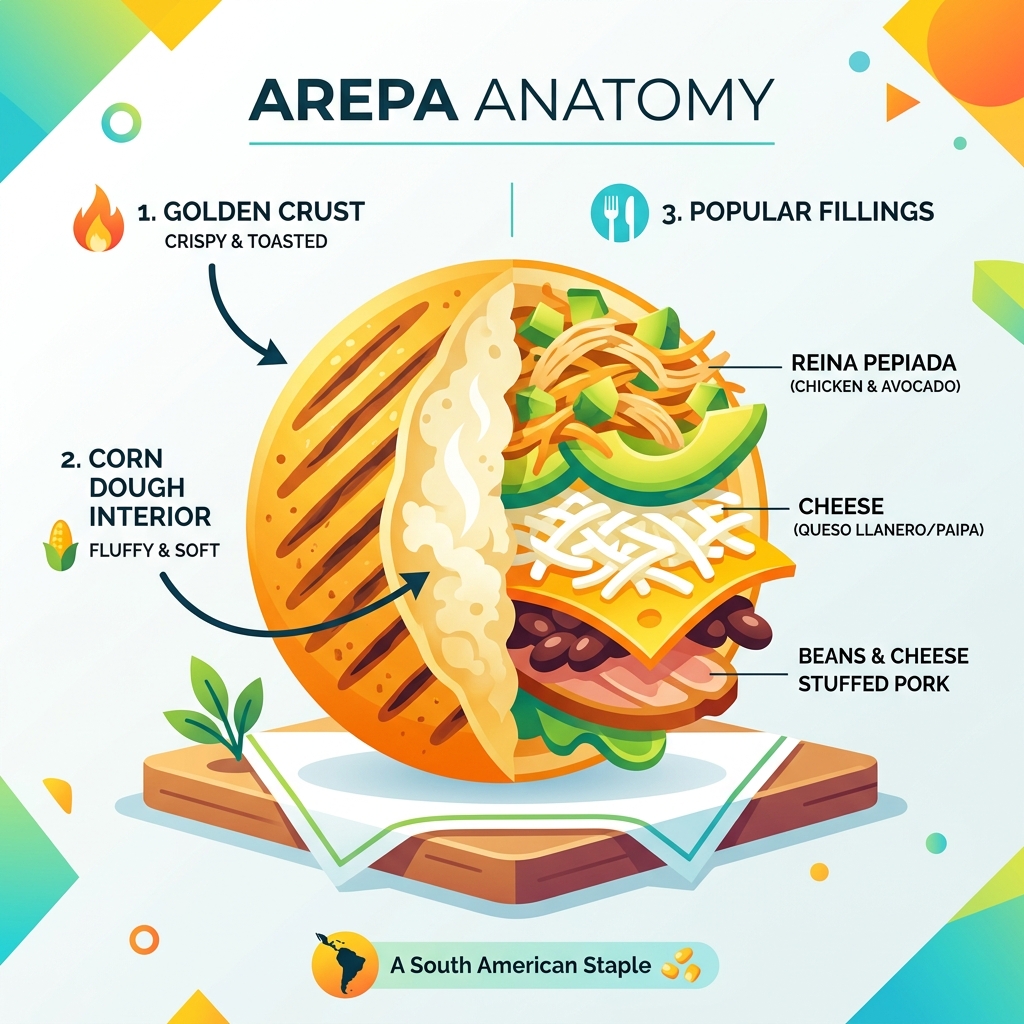
- Most popular filling: Reina Pepiada (shredded chicken and avocado)
- Key brands: Harina P.A.N., Masarepa (Goya), Areparina
Think of an arepa the way you'd think of an English muffin — a simple, versatile base that becomes whatever you put inside it. "Life is like an arepa," the Venezuelan saying goes. "The flavor depends on what you spread in it."
That's exactly what makes this food so beloved. With just three ingredients and about 30 minutes, you get something that has fed communities across South America for roughly 3,000 years. Maize cultivation in Colombia dates back around 6,000 years, and the arepa has remained largely unchanged since pre-Columbian times — one of the few pre-contact food traditions still thriving today.
Whether you're new to arepas or looking to deepen your appreciation for this corn cake, this guide covers everything: history, ingredients, regional styles, iconic fillings, and how to make them at home.
Essential arepa terms:
The History and Etymology of the Arepa
The story of the arepa begins long before the arrival of Europeans in the Americas. It is a culinary legacy of the indigenous peoples who inhabited the northern regions of South America, specifically what we now know as Venezuela and Colombia.
Etymologically, the word "arepa" is believed to stem from the Cumanagoto word erepa, which simply means "maize" or "cornbread." The Cumanagoto people lived in the region of Cumaná, Venezuela. Other indigenous groups used similar terms, such as tijitafun among certain Chibcha-speaking tribes. Early Spanish chroniclers, such as Pedro Cieza de León in 1554, noted the consumption of these corn cakes, even suggesting they were more nutritious and flavorful than the wheat bread found in Europe at the time.
Historical context of the arepa shows that while both Venezuela and Colombia claim the arepa as their national dish, it is truly a shared heritage born from the era of Gran Colombia. Archaeological evidence of Andean maize suggests that maize has been a dietary staple in the Southwest Colombian and Venezuelan Andes for nearly 3,000 years.
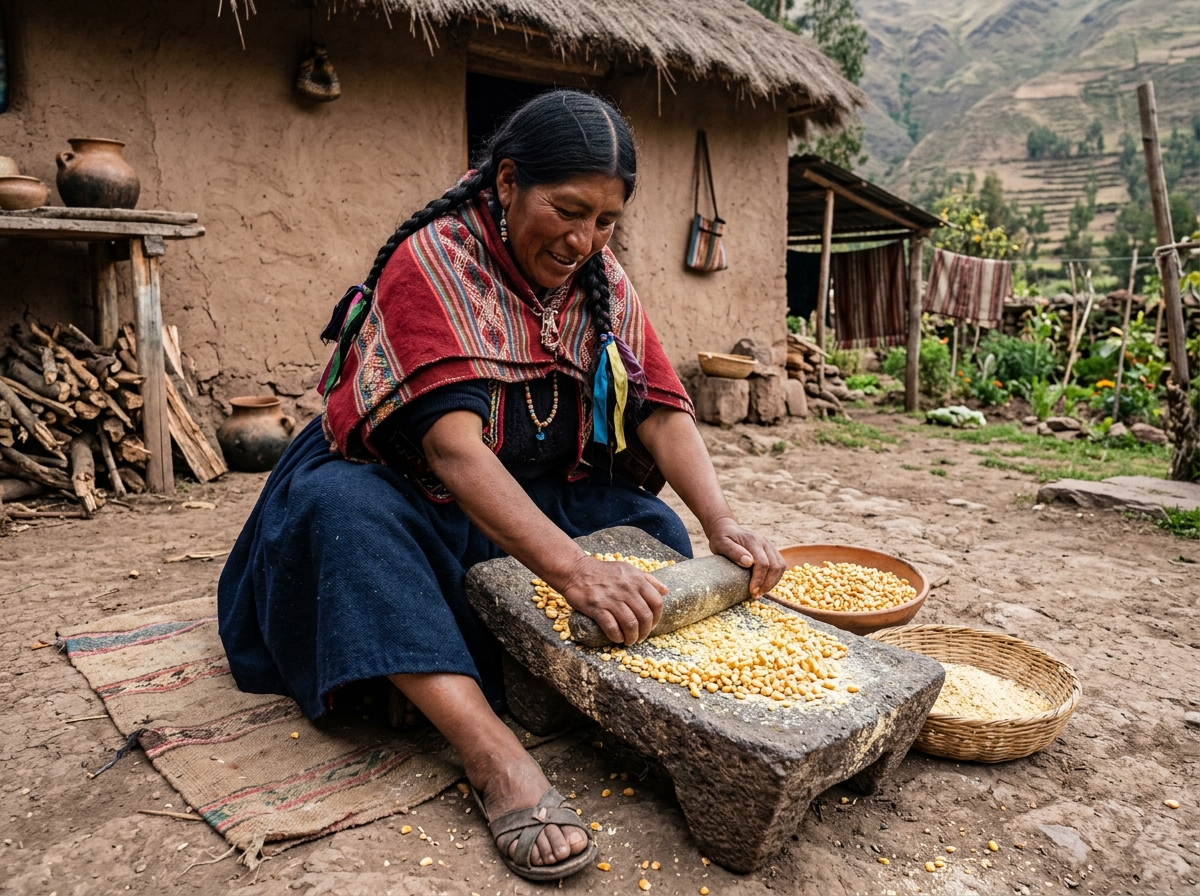
Historically, preparing the dough was a labor-intensive process. Women would soak the corn, remove the hull (a process sometimes involving ash or lime, similar to nixtamalization), boil it, and then grind it by hand on large stones or batanes. The resulting masa was shaped into discs and cooked on a budare—a flat clay or iron griddle placed over an open fire. While industrialization has changed how we make the dough, the fundamental shape and spirit of the arepa remain unchanged.
Essential Ingredients and Preparation Methods
Making an arepa is deceptively simple. Unlike bread, it requires no yeast or long proofing times. The magic lies in the hydration of the cornmeal and the development of a crispy outer crust.
The standard ratio for a basic batch of 8 arepas is:
- 2 cups (approx. 300g) of precooked cornmeal
- 2 to 2 ¼ cups of warm water
- 1 teaspoon of salt
- Optional: A tablespoon of oil or melted butter for a richer dough
Mixing the dough is a sensory experience. We recommend adding the cornmeal gradually to the salted water, whisking or kneading with your hands to prevent lumps. The dough should rest for about 5 to 10 minutes to allow the cornmeal to fully hydrate. If the edges of your discs crack when you flatten them, the dough is too dry—simply add a tablespoon of water. If it sticks to your hands, add a little more flour.
Choosing the Right Flour for Your Arepa
You cannot make an authentic arepa with standard cornmeal, cornstarch, or polenta. You must use harina de maíz precocida (precooked cornmeal). This flour has been cooked, dried, and ground, allowing it to form a dough instantly when mixed with liquid.
Historically, Harina P.A.N. is the most iconic brand. Patented in Venezuela in 1954 by Dr. Luis Caballero Mejía and later popularized by Empresas Polar in 1960, it revolutionized South American kitchens by eliminating the need for hours of manual grinding. Today, you can find both white and yellow varieties. For those looking for options, more info about precooked cornmeal products highlights Goya’s Masarepa, which is widely available across Los Angeles markets from Hollywood to Venice.
| Feature | Arepa Flour (Masarepa) | Tortilla Masa (Nixtamalized) |
|---|---|---|
| Process | Precooked and ground | Treated with lime (nixtamalized) |
| Texture | Gritty to smooth, cake-like | Elastic and earthy |
| Result | Thick patty with soft interior | Thin, flexible flatbread |
Traditional Cooking Tools and Techniques
The most important tool for any arepa enthusiast is the budare. Traditionally made of clay and now more commonly cast iron, this flat griddle provides the even heat necessary to create a "shell."
To achieve the perfect texture, we use a three-step method:
- Searing: Place the discs on a hot, lightly oiled griddle for 5–7 minutes per side until golden brown spots appear.
- The "Patty-Cake" Technique: When shaping, rotate the dough ball between your palms to flatten it evenly to about ½ to ¾ inch thick.
- The Oven Finish: To get that signature puffiness and a soft, steamy interior, transfer the seared arepas to a 400°F oven for about 10 minutes.
How do you know it’s done? Give it a light tap with your finger. If it sounds hollow, like a drum, it’s ready to eat.
Regional Variations and Iconic Fillings
While the base dough is similar, how the arepa is served varies wildly between regions. In Colombia, you might find over 75 different preparations, whereas in Venezuela, the focus is often on the creative and hearty "rellenos" (fillings).
In Colombia, the history of Colombian arepa festivals celebrates this diversity. Some notable styles include:
- Arepa de Choclo: Made from sweet, fresh corn (sweet corn) and usually served folded over a thick slice of queso de mano or mozzarella.
- Arepa Paisa: A very thin, white corn arepa from the Medellin region, often served plain as a side for eggs or grilled meats.
- Arepa de Huevo: A Caribbean specialty where a partially cooked arepa is slit open, a raw egg is poured inside, and the whole thing is deep-fried until the egg is set.
The Venezuelan Arepa: A Canvas for Fillings
In Venezuela, the arepa is almost always a sandwich. After cooking, it is sliced open (but not all the way through) to create a pocket.
The most legendary variety is the Reina Pepiada. Invented in 1955 by the Alvarez brothers in Caracas, it was named in honor of Susana Duijm, the first Venezuelan to win Miss World. "Reina" means queen, and "pepiada" was 1950s slang for a curvaceous or "hot" woman. The filling is a lush salad of shredded chicken, mayonnaise, and plenty of avocado.
Other iconic fillings include:
- Carne Mechada: Savory, slow-shredded beef.
- Pabellón: A miniature version of the national dish, stuffed with shredded beef, black beans, sweet plantains, and salty white cheese.
- Dominó: Black beans and white cheese (resembling domino tiles).
- Pelúa: Shredded beef and yellow cheddar cheese (the cheese looks like "hair," or pelo).
Global Adaptations and Similar Foods
The arepa is part of a broader family of Mesoamerican and South American corn traditions. It shares DNA with the Salvadoran pupusa, though pupusas are stuffed before cooking. It is also similar to the Mexican gordita, which is nixtamalized and often deep-fried.
Interestingly, the arepa has also traveled across the Atlantic. Due to historical migration between Venezuela and the Canary Islands, the arepa is now a common sight in Spanish island cuisine, often filled with local cheeses and meats.
Nutritional Benefits and Storage Tips
For the health-conscious Angeleno, the arepa is a fantastic alternative to wheat bread. It is naturally gluten-free, making it a staple for those with celiac disease or gluten sensitivities. Because it is made from whole corn, it provides complex carbohydrates and fiber.
Many modern cooks enrich their dough for added nutrition. We’ve seen wonderful variations in L.A. kitchens—from Santa Monica to Silverlake—incorporating:
- Vegetable Purees: Adding beet, spinach, or carrot puree to the water for colorful, vitamin-rich arepas.
- Seeds: Mixing in chia, flax, or hemp seeds for an omega-3 boost.
- Fiber: Adding afrecho (wheat bran) or oats to the masa.
Storage and Reheating
If you make a big batch, you’re in luck. Research on corn arepa shelf life shows that while fresh is best, they store remarkably well.
- Fridge: Store cooked arepas in an airtight bag for up to 3 days.
- Freezer: You can freeze uncooked dough discs (separated by parchment paper) or fully cooked arepas for up to a month.
- Reheating: To bring a cold arepa back to life, moisten the surface with a little water and toast it on a hot griddle or in a toaster oven until the crust is crispy again. Avoid the microwave, as it can make them rubbery.
Frequently Asked Questions
Is the arepa Venezuelan or Colombian? The short answer is: both. While both nations have distinct styles and cultural claims, the arepa predates modern borders. It belongs to the indigenous heritage of the entire northern Andean region.
Can I use regular cornmeal or polenta? No. Regular cornmeal is too coarse and isn't precooked, so it won't bind into a dough. Polenta is also not a suitable substitute as it lacks the starch consistency needed to form a patty that won't fall apart on the griddle.
How do I prevent the dough from cracking? Cracks are a sign of dehydration. Always let your dough rest for 5 minutes so the corn can absorb the water. If it still cracks when you press it down, knead in a little more warm water. Keeping a small bowl of water nearby to dampen your hands while shaping also helps.
Conclusion
The arepa is more than just a corn cake; it is a symbol of resilience, cultural identity, and culinary creativity. From its humble pre-Hispanic roots to its status as a global street food icon, it has remained a "blank canvas" for the flavors of the world.
Whether you're grabbing a Reina Pepiada at a local spot in Downtown L.A. or flipping your first batch on a cast-iron skillet in your Echo Park kitchen, you are participating in a tradition that spans millennia. At Edible L.A., we love how the arepa has found a second home in our diverse city, blending perfectly with our local love for high-quality, seasonal ingredients.
Ready to start your own corn-filled journey? Explore more local L.A. recipes and discover the stories behind the foods that shape our community.